Maths Olympiad Prep

Library / Romania — NMO Selection Tests for the Balkan and International Mathematical Olympiads /55 of 80

Romania — NMO Selection Tests for the Balkan and International Mathematical Olympiads

Geometry Difficulty 8.4 Shortlist Prove it Romania

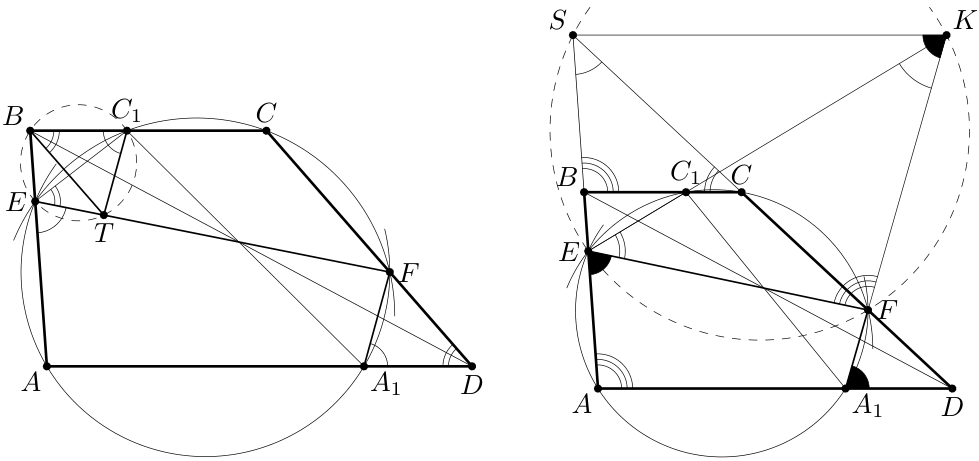
Let ABCDABCD be a trapezium, AD∥BCAD \parallel BC, and let EE and FF be points on the sides ABAB and CDCD, respectively. The circumcircle of the triangle AEFAEF meets the line ADAD again at A1A_1, and the circumcircle of the triangle CEFCEF meets the line BCBC again at C1C_1. Prove that the lines A1C1A_1C_1, BDBD, and EFEF are concurrent.

Solution

First solution. Let the line EFEF meet the circle C1BEC_1BE again at TT. Then
∠(TC1,C1B)=∠(TE,EB)=∠(FE,EA)=∠(FA1,A1A), \angle (TC_1, C_1B) = \angle (TE, EB) = \angle (FE, EA) = \angle (FA_1, A_1A),
so TC1TC_1 and FA1FA_1 are parallel. Similarly,
∠(TB,BC1)=∠(TE,EC1)=∠(FE,EC1)=∠(FC,CC1)=∠(FD,DA1), \angle (TB, BC_1) = \angle (TE, EC_1) = \angle (FE, EC_1) = \angle (FC, CC_1) = \angle (FD, DA_1),
so TBTB and FDFD are parallel.
Thus, the corresponding sides of the triangles A1DFA_1DF and C1BTC_1BT are parallel. Since the vectors C1B→\overrightarrow{C_1B} and A1D→\overrightarrow{A_1D} are counter-directed, these triangles are homothetical under a homothety of negative ratio.
The centre of this homothety OO lies on the lines BDBD, A1C1A_1C_1, and TF=EFTF = EF, so the three are concurrent.

Figure 1

Second solution. Let the lines ABAB and CDCD meet at SS, and let the lines A1FA_1F and C1EC_1E meet at KK. Since
∠(EK,FK)=∠(EC1,EF)+∠(EF,A1F)=∠(CC1,CF)+∠(EA,AA1)=∠(BC,FS)+∠(ES,BC)=∠(ES,FS), \begin{align*} \angle(EK, FK) &= \angle(EC_1, EF) + \angle(EF, A_1F) = \angle(CC_1, CF) + \angle(EA, AA_1) \\ &= \angle(BC, FS) + \angle(ES, BC) = \angle(ES, FS), \end{align*}
the points EE, FF, SS, and KK are concyclic. Thus ∠(KS,KF)=∠(ES,EF)=∠(EA,EF)=∠(A1A,A1F)\angle(KS, KF) = \angle(ES, EF) = \angle(EA, EF) = \angle(A_1A, A_1F), showing that KSKS is parallel to both ADAD and BCBC.
This shows the triangles A1DFA_1DF and C1BEC_1BE in perspective from the ideal point of the three parallel lines, so the lines A1C1A_1C_1, BDBD and EFEF are concurrent, by Desargues' theorem; since the segments A1C1A_1C_1 and BDBD have a non-empty intersection, the point of concurrency is not ideal.

Want a route through all this instead of an archive? The track puts 2,604 problems in a working order, from Junior Challenge level to the IMO shortlist.

Source: MathNet, licensed CC-BY-4.0. Statement reproduced verbatim; metadata (topic, difficulty) added by this project.