Maths Olympiad Prep

Library / /4 of 4

Geometry Difficulty 7.2 National olympiad, round 2 Prove it Vietnam

In plane, let be given a fixed circle (O)(O) with radius RR, two fixed points AA, BB on the circle (O)(O) such that AA, BB, OO are not collinear.
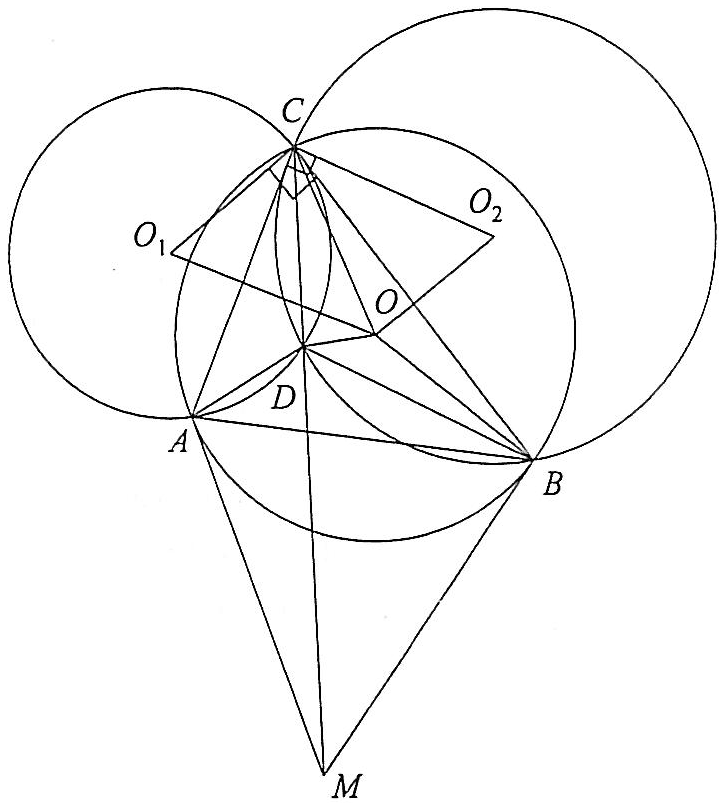
Let CC be a point on (O)(O) distinct from AA and BB. Construct the circle (O1)(O_1) passing through AA, touching the line BCBC at CC, construct the circle (O2)(O_2) passing through BB, touching the line ACAC at CC. The circle (O1)(O_1) and (O2)(O_2) intersect again at DD distinct from CC.
Prove that
i)CDR; i) \, CD \le R;
ii)The line CD passes through a fixed point when C moves on (O) so that C does not coincide with A and B.ii) \text{The line } CD \text{ passes through a fixed point when } C \text{ moves on } (O) \text{ so that } C \text{ does not coincide with } A \text{ and } B.
((O)(O) denotes a circle with center OO.)

Solution

1) From the construction of the circles (O1)(O_1) and (O2)(O_2), we have:
CAD=DCB (subtend the arc CD of (O1))(1) \angle CAD = \angle DCB \ (\text{subtend the arc } CD \text{ of } (O_1)) \quad (1)
ACD=CBD (subtend the arc CD of (O2))(2) \angle ACD = \angle CBD \ (\text{subtend the arc } CD \text{ of } (O_2)) \quad (2)
Therefore DACDCB\triangle DAC \sim \triangle DCB and so
DADC=DBDB, i.e. CD2=DADB(3) \frac{DA}{DC} = \frac{DB}{DB}, \text{ i.e. } CD^2 = DA \cdot DB \quad (3)
Figure 1
The law of cosines for triangle ADBADB gives
AB2=AD2+DB22ADDBcos(ADB), soAB22ADDB(1cos(ADB))(4) AB^2 = AD^2 + DB^2 - 2AD \cdot DB \cos(\angle ADB), \text{ so} \\ AB^2 \geq 2AD \cdot DB(1 - \cos(\angle ADB)) \quad (4)
(3) and (4) imply that
AB22CD2(1cos(ADB))(5) AB^2 \geq 2CD^2(1 - \cos(\angle ADB)) \quad (5)
The law of sines for triangle ABCABC gives AB=2Rsin(ACB)AB = 2R \sin(\angle ACB). So, from (5), we deduce that
2R2sin2(ACB)CD2(1cos(ADB)).(6) 2R^2 \sin^2(\angle ACB) \geq CD^2(1 - \cos(\angle ADB)). \quad (6)
From (1) and (2), we see that
CAD+ACD=DCB+CBD=CAD+CBD==DCB+DCA=ACB(7) \begin{aligned} \angle CAD + \angle ACD &= \angle DCB + \angle CBD = \angle CAD + \angle CBD = \\ &= \angle DCB + \angle DCA = \angle ACB \end{aligned} \quad (7)
Therefore
ADC=BDC=180ACB(8) \angle ADC = \angle BDC = 180^\circ - \angle ACB \quad (8)
Moreover, it is easily seen that:
- CC, DD lie on the same side with respect to the line ABAB
CAD+CBD<CAB+CBA; \Leftrightarrow \angle CAD + \angle CBD < \angle CAB + \angle CBA;
- CC, DD lie on distinct sides with respect to the line ABAB
CAD+CBD>CAB+CBA. \Leftrightarrow \angle CAD + \angle CBD > \angle CAB + \angle CBA.
So, from (7), we deduce that:
- If ACB\angle ACB is acute then CC, DD lie on the same side with respect to the line ABAB;
- If ACB\angle ACB is obtuse then CC, DD lie on distinct sides with respect to the line ABAB.
Therefore, from (8),
when ACB\angle ACB is acute,
ADB=360(ADC+CDB)=2ACB \angle ADB = 360^\circ - (\angle ADC + \angle CDB) = 2\angle ACB
when ACB\angle ACB is obtuse,
ADB=ADC+CDB=3602ACB. \angle ADB = \angle ADC + \angle CDB = 360^\circ - 2\angle ACB.
So, in all cases, cos(ADB)=cos(2ACB)\cos(\angle ADB) = \cos(2\angle ACB).
Hence, from (6), we have CDRCD \le R,
QED.

2) From the preceding results, it is easily seen that:
CD is the angle bisector of ADB;(9) - CD \text{ is the angle bisector of } \angle ADB; \qquad (9)
O,D lie on the same side with respect to the line AB;(10) - O, D \text{ lie on the same side with respect to the line AB;} \qquad (10)
ADB=AOB.(11) - \angle ADB = \angle AOB. \qquad (11)
From (10), (11) we deduce that: when CC moves on (O)(O) (but CC distinct from A,BA, B), the point DD moves on the arc AOBAOB of the fixed circle (AOB)(AOB). Therefore, (9) proves that the line CDCD passes through a fixed point, namely the middle point MM of the arc ABAB not containing OO of the circle (AOB)(AOB).

Want a route through all this instead of an archive? The track puts 2,000 problems in a working order, from AMC 10 level to the IMO shortlist.

Source: MathNet, licensed CC-BY-4.0. Statement and solution reproduced as published; topic and difficulty added by this site.