Maths Olympiad Prep

Library / /24 of 38

Geometry Difficulty 6.9 National olympiad Prove it China

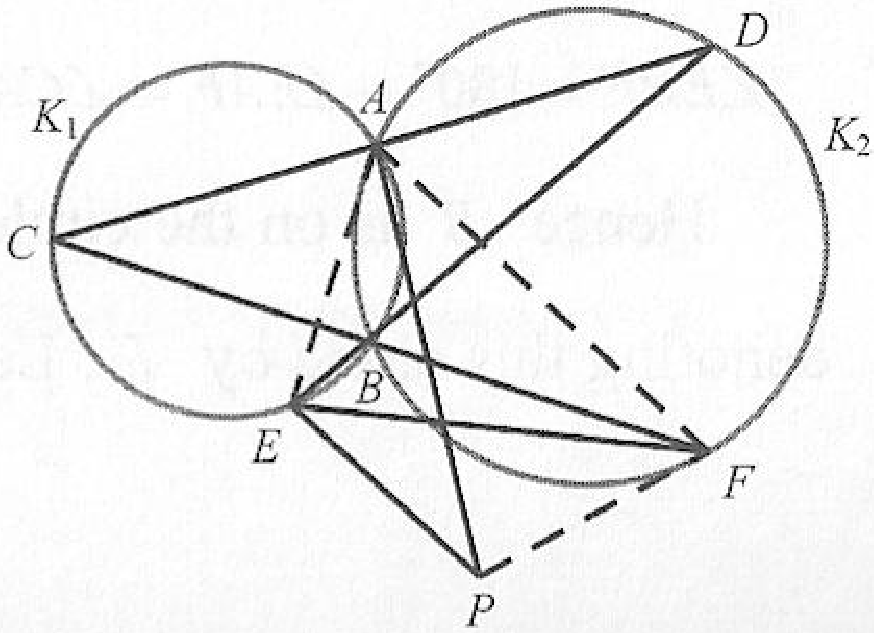
Two circles K1K_1 and K2K_2 of different radii intersect at two points AA and BB, let CC and DD be two points on K1K_1 and K2K_2, respectively, such that AA is the midpoint of the segment CDCD. The extension of DBDB meets K1K_1 at another point EE, the extension of CBCB meets K2K_2 at another point FF. Let l1l_1 and l2l_2 be the perpendicular bisectors of CDCD and EFEF, respectively.

(1) Show that l1l_1 and l2l_2 have a unique common point (denoted by PP).

(2) Prove that the lengths of CACA, APAP and PEPE are the side lengths of a right triangle.

Figure 1

Solution

(1) Since CC, AA, BB, EE are concyclic, and DD, AA, BB, FF are concyclic, CA=ADCA = AD, and by the theorem of power of a point, we have
CBCF=CACD=DADC=DBDE.1 CB \cdot CF = CA \cdot CD = DA \cdot DC = DB \cdot DE. \qquad \textcircled{1}
Suppose on the contrary that l1l_1 and l2l_2 do not intersect, then CDEFCD \parallel EF, hence CFCB=DEDB\frac{CF}{CB} = \frac{DE}{DB}. Plugging into (1), we get CB2=DE2CB^2 = DE^2, thus CB=DBCB = DB, hence BACDBA \perp CD. It follows that CBCB and DBDB are the diameters of K1K_1 and K2K_2 respectively, hence K1K_1 and K2K_2 have same radii, which contradicts with assumption. Thus l1l_1 and l2l_2 have a unique common point.

(2) Join AEAE, AFAF and PFPF, we have
CAE=CBE=DBF=DAF. \angle CAE = \angle CBE = \angle DBF = \angle DAF.
Since APCDAP \perp CD, APAP is the bisector of EAF\angle EAF. Since PP is on the perpendicular bisector of the segment EFEF, PP is on the circumcircle of AEF\triangle AEF. We have
EPF=180EAF=CAE+DAF=2CAE=2CBE. \angle EPF = 180^\circ - \angle EAF = \angle CAE + \angle DAF = 2\angle CAE = 2\angle CBE.
Hence BB is on the circle with center PP and radius PEPE, denoting this circle by Γ\Gamma. Let RR be the radius of Γ\Gamma. By the

theorem of power of a point, we have
2CA2=CACD=CBCF=CP2R2, 2CA^2 = CA \cdot CD = CB \cdot CF = CP^2 - R^2,
thus
AP2=CP2CA2=(2CA2+R2)CA2=CA2+PE2. AP^2 = CP^2 - CA^2 = (2CA^2 + R^2) - CA^2 = CA^2 + PE^2.
It follows that CACA, APAP, PEPE form the side lengths of a right triangle.
Want a route through all this instead of an archive? The track puts 2,000 problems in a working order, from AMC 10 level to the IMO shortlist.

Source: MathNet, licensed CC-BY-4.0. Statement and solution reproduced as published; topic and difficulty added by this site.