Let be a triangle. The -angle bisector intersects at . Let , be the circumcenters of triangles , , respectively. Given that the circumcenter of triangle lies on , find all possible values of . (Patrik Bak)
Czech and Slovak Mathematical Olympiad
Solution
Let be the circumcenter of triangle and denote . Since and are acute (Fig. 2), points , lie in the half-plane and the Inscribed angle theorem yields
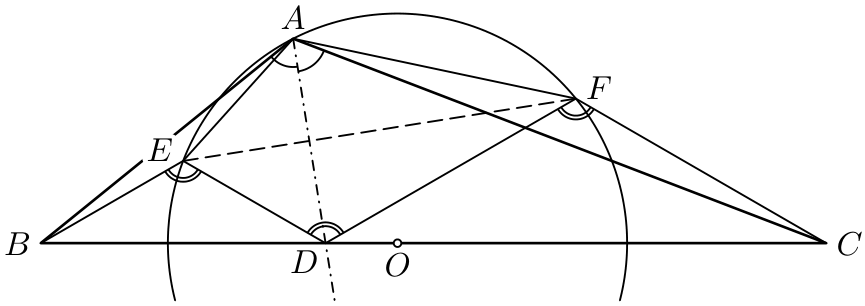
Fig. 2
The isosceles triangles and are thus similar and we easily compute that and that is the external -angle bisector in triangle .
Point lies on and on the perpendicular bisector of . Framed with respect to triangle , it lies on the external -angle bisector and on the perpendicular bisector of the opposite side . Thus it is the midpoint of arc and .
Quadrilateral is a kite, hence . Moreover, line separates points and , thus the Inscribed angle theorem implies that the size of the reflex angle is twice the size of the convex angle . This yields and .
Want a route through all this instead of an archive? The track
puts 2,604 problems in a working order, from Junior Challenge level to the IMO shortlist.