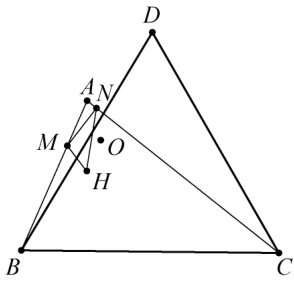
Let H be the orthocenter of an acute-angled △ABC with ∠A>60∘. Let points M and N be on sides AB and AC, respectively, such that ∠HMB=60∘=∠HNC. Let O be the circumcenter of △HMN. Let points D and A be on the same side of line BC, such that △DBC is regular (see Fig. 1.1). Prove that points H, O and D are collinear. (posed by Zhang Sihui)
Solution
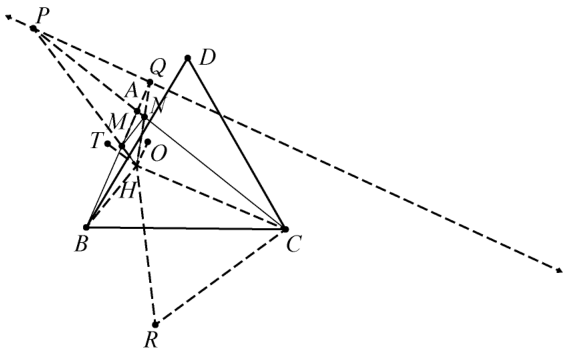
Let T be the orthocenter of △HMN. Extended lines of HM and CA intersect at point P. Extended lines HN and BA intersect at point Q. It is easy to see that points N, M, P and Q are concyclic.
By ∠THM=∠OHN, we see that ∠PQH−∠OHN=∠NMH−∠THM=90∘, that is, HO⊥PQ.① Let point R be symmetric to point C over HP. Then HC=HR. By ∠HPC+∠HCP=(∠BAC−60∘)+(90∘−∠BAC)=30∘, we see that ∠CHR=60∘. Hence △HCR is regular. By ∠HPC=∠HQB and ∠HCP=∠HBQ, we see that △PHC∼△QHB. Then △PHR∼△QHB, so △QHP∼△BHR. Denote by ∠(UV,XY) the angle between UV and XY (positive anticlockwise). Since ∠PHR=150∘, we have ∠(PQ,RB)=∠(HP,HR)=150∘, △BCD and △RCH are regular. So △BRC≅△DHC. Hence ∠(RB,HD)=∠(CR,CH)=−60∘.
Consequently, ∠(PQ,HD)=∠(PQ,RB)+∠(RB,HD)=150∘−60∘=90∘, that is DH⊥PQ.2◯ By ① and ②, points H, O and D are collinear. □
Want a route through all this instead of an archive? The track
puts 2,604 problems in a working order, from Junior Challenge level to the IMO shortlist.
Source: MathNet,
licensed CC-BY-4.0.
Statement reproduced verbatim; metadata (topic, difficulty) added by this project.