Let be the sum of all 10 pairwise products of the sides of a convex pentagon, be the area of the pentagon.
a) Prove that .
b) Does there exist a constant such that ?
(I. Voronovich)
Let be the sum of all 10 pairwise products of the sides of a convex pentagon, be the area of the pentagon.
a) Prove that .
b) Does there exist a constant such that ?
(I. Voronovich)
Answer: b) yes.
We use the following well-known
Lemma. Let be the lengths of the sides of some quadrilateral, and be its area. Then and .
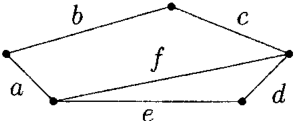
Let now be the lengths of the sides of the given pentagon, be the length of one of its diagonals (see the Fig.), be its area. Then , i.e. . Note that all summands in parentheses are the products of the neighboring sides of the pentagon, while is the product of non-neighboring sides.
Summing all similar inequalities which we can obtain by the cyclic permutation , we get
where is the sum of all five pairwise products of the neighboring sides, is the sum of all five pairwise products of the non-neighboring sides.
Further, . In the same way we obtain from the last inequality the following one
Summing (1) and (2) gives the required inequality.