Let be an equilateral trapezoid with sides and . The incircle of the triangle touches at . Point is chosen on the bisector of the angle such that the lines and are perpendicular. The circumcircle of the triangle intersects the line again at . Prove that the triangle is isosceles.
6-th Czech-Slovak Match
Solution
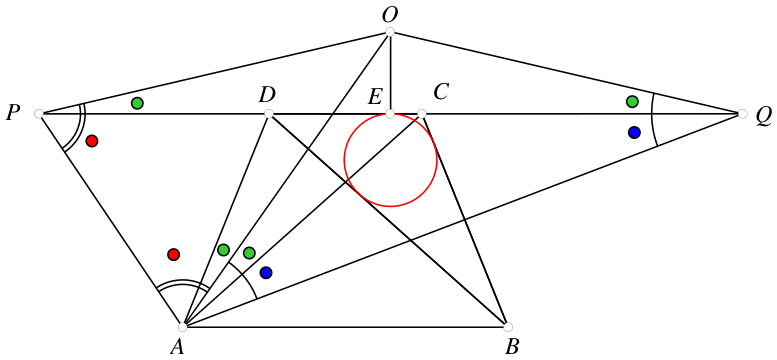
Let us show that . We will proceed: from behind. On the extension of we take the point such that and similarly on extension of we take the point such that . Then, using well known properties of the incircle, we have
This means that the line is the axis of the segment . In particular, it means that the circumcenter of triangle lies on the line as well as on the axes of segments and . This means that
So points and coincide. Moreover
Therefore the points , , , are concyclic. Thus, necessarily , and thus . We have proved what we need.
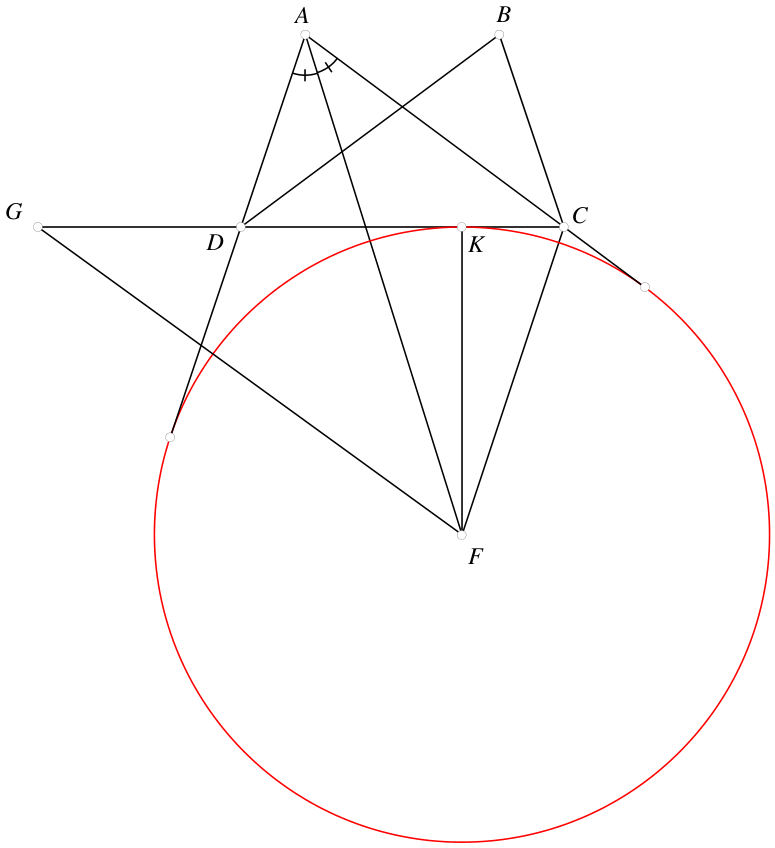
We will show that . Let be the center of the excircle of triangle opposite vertex . Then lies on the angle bisector . Let be the point where this excircle touches . By a standard computation using equal tangents, we see that . By a similar computation in triangle , we see that . Therefore and .
Since is now known to be an excenter, we have that is the external angle bisector of . Therefore
We conclude that the triangle is isosceles with , as desired.
Want a route through all this instead of an archive? The track
puts 2,604 problems in a working order, from Junior Challenge level to the IMO shortlist.