Points , , , lie on a circle in this order, where and are not parallel. The length of the arc that contains points , is twice as large as the length of the arc that does not contain points , . Point is chosen such that and and lies on the same side of the line as and . Assuming that the perpendicular line from the point to the line bisects the arc not containing points , , prove that .
, 2011
Solution
We use the following lemma
LEMMA. Given two circles , with the centre of lying on the circle . The circles intersect in two points and . Let be the point on the circle (different from and ) and the line meets again in . Then .
*Proof.*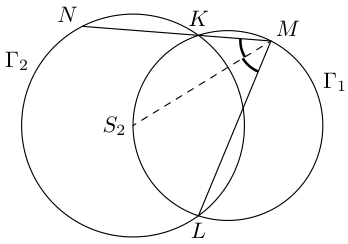
Fig. 1a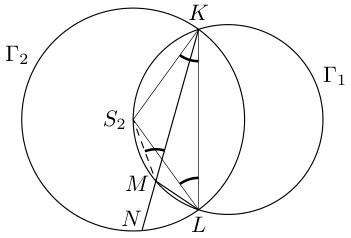
Fig. 1b
For this lemma it is sufficient to prove that the line bisects the angle . Then in the reflection with respect to the line , is the image of . The circle and the point reflect to themselves, the point reflects to the point (the intersection point of and ). So the triangle is isosceles (some considerations are needed according to the position of the point ).
Firstly, let lie on the arc not containing the point . As , we directly have . Secondly, let lie on the arc containing point . Let be an arbitrary point on the arc not containing the point . Similarly as before , then using identical angles in the cyclic quadrilaterals and we obtain .
Let the perpendicular line from the point to the line intersect the arc in the point , be the circle centered in passing through , be the circle centered in passing through , be the circle passing through , , , . The line intersects again in and the line intersects again in . Circles and meet in , and circles and meet in , . Using the lemma we have and . Let the circles and meet again in . Using a contradiction, we shall prove that .
The point lies on the chord of the circles and . That means its powers to these two circles are equal. We know that bisects the arc , so and consequently . If and are different points then the triangle is isosceles and its altitude from passes through the circumcentre of and consequently (by the symmetry) the quadrilateral is isosceles trapezoid (). We can find points and as the intersection points of the axes of the segments and with . But then also is an isosceles trapezoid, , which is a contradiction to the given .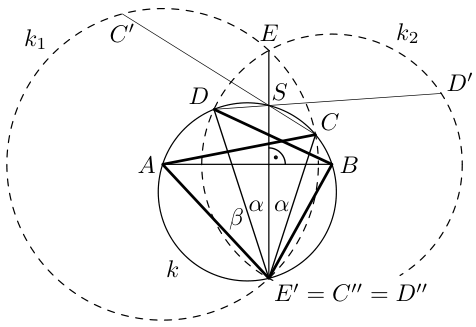
If we denote and then because . Using and we compute the angles in the triangle :
which yields to
and .
Looking for a route rather than an archive? The track puts 2,000
problems in a working order, from AMC 10 level to the IMO shortlist.