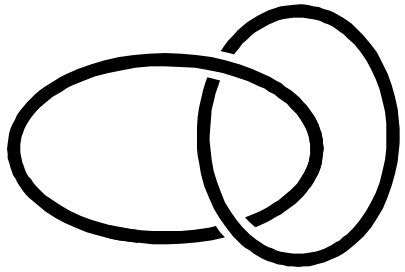
The points should be on a circle (or line) and A, B should separate A′, B′ on it. To prove necessity, first suppose that the points are not coplanar. Then there exist two parallel planes passing through A, B and A′, B′ respectively. Any two circles in these planes are not linking. So the points should be coplanar.
Now suppose B′ is not on the circumcircle of ABA′ (which can be a line). So we can slightly change the circle to find a circle passing through A, B such that A′, B′ are both outside or both inside it. Now, this circle is not linking with the circle with diameter A′B′ orthogonal to the plane containing the points.
So the points should be on a circle (or line). Now, suppose A, B do not separate A′, B′ on the circle. If we change the circle slightly, still passing through A, B, then A′, B′ will be both inside or both outside the new circle and we arrive to a contradiction like the previous case. So, the necessity of the condition is proved.
To prove sufficiency, Let C, C′ be two different circles passing through A, B and A′, B′ respectively. Let P, P′ be the planes containing C, C′ respectively. If the points are collinear, then C′∩P is consisted of a point inside C and a point outside C. So C, C′ are interlocked. So, suppose the points are on a circle. Let M be the intersection of the segments AB and A′B′. We have MA⋅MB=MA′⋅MB′. Let
l=P∩P′ which passes through M. M is inside C, so l intersects C at two points like X,Y and M is between X,Y. Similarly, l intersects C′ at X′,Y′ namely, and M is between X′,Y′. Suppose X,X′ are in one side of M. We have
MX⋅MY=MA⋅MB=MA′⋅MB′=MX′⋅MY′
So if MX≤MX′, then MY≥MY′ and vice versa. So the points of C′∩P={X′,Y′} are in different sides of C or both are on C. So C,C′ are linking and sufficiency of the condition is proved. □