Name ∠BAD=α, ∠BCD=2α, ∠ADC=β, ∠ABC=2β. The interior angles of ABCD add up to 3α+3β=360∘. Hence, α+β=120∘. As α=β, we may assume without loss of generality that β<60∘<α.
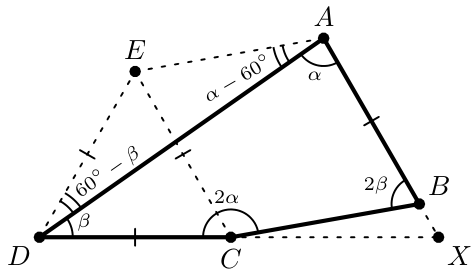
Let X=AB∩CD. Notice that ∠AXD=60∘. Let E be the point on the same side as A with respect to line CD such that CDE is equilateral. We have ∠ECD=60∘=∠AXD and CE=CD=AB. Hence, EC∥AB and ABCE is a parallelogram. This implies ∠BAE=∠BCE=2α−60∘ and ∠EAD=(2α−60∘)−α=α−60∘. On the other hand, ∠EDA=60∘−β. Since 60∘−β=α−60∘>0, triangle AED is isosceles with AE=ED. Hence, ABC and BCD are also isosceles. In particular ∠BAC=2180∘−∠ABC=90∘−β, which implies ∠CAD=α−(90∘−β)=30∘; and ∠BDC=2180∘−∠BCD=90∘−α, which implies ∠BDA=β−(90∘−α)=30∘. Therefore, the acute angle formed by AC and BD is 30∘+30∘=60∘.