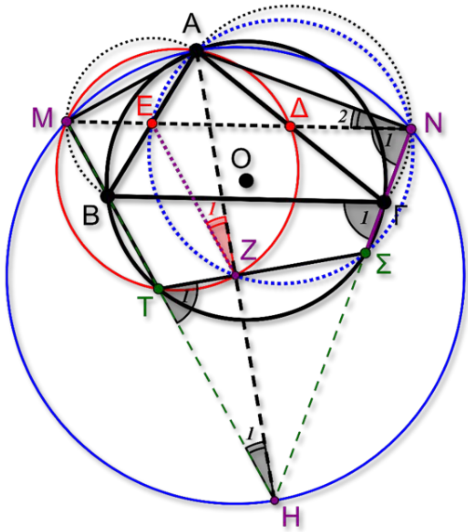
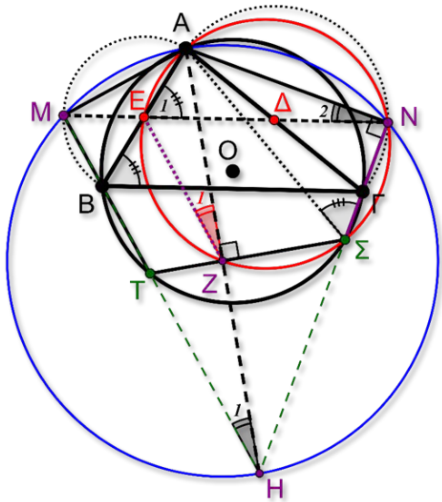
Let ABΓ be an acute angled triangle with AB<AΓ<BΓ. Its circumcircle is c and let Δ,E be the midpoints of AB and AΓ respectively. We draw externally two semicircles with diameters AB and AΓ, which intersect EΔ at M and N respectively. The lines MB and MΓ intersect the circumcircle at T,Σ respectively. If the lines MB and MΓ intersect at H, prove that:
a) the point H is on the circumcircle of the triangle AMN
b) the lines AH and TΣ intersect perpendicularly at the point Z and Z is the center of the circumcircle of the triangle AMN.
Solution
a. The angles AMB and ANΓ are right since they see the diameters AB and AΓ. Therefore the quadrilateral AMHN is cyclic, which is the desired result.
b. T^1=I^1(1).
The line EΔ connects the midpoints of AB and AΓ, so MN is parallel to BΓ. Therefore:
r^1=N^1(2).
From the quadrilateral AMHN we have: H^1=N^2(3). From the relations (1), (2), (3) we have: T^1+H^1=N^1+N^2=AN^H=90∘.
From the quadrilateral ABΣΓ we have: AB^Γ=AΣ^Γ=B^and from EΔ∥BΓ we have: E^1=B^. From the equality AΣ^Γ=AΣ^N in combination with the previous ones we get that the quadrilateral AEΣN is cyclic.
The quadrilateral AZΣN is also cyclic, since AN^Σ=AZ^Σ=90∘. To this end, we have that Z^1=N^2=H^1 and so BH∥EZ. Since E is the midpoint of AB, we conclude that Z is the midpoint of AH.
Want a route through all this instead of an archive? The track
puts 2,604 problems in a working order, from Junior Challenge level to the IMO shortlist.
Source: MathNet,
licensed CC-BY-4.0.
Statement reproduced verbatim; metadata (topic, difficulty) added by this project.