For what positive integers does there exist a polygon with vertices (not necessarily convex) with the property that each of its sides is parallel to another one of its sides?
Slovenia — National Math Olympiad
Solution
If is even, , then such a polygon exists since every regular -gon satisfies the condition.
If or , then such a polygon does not exist. Indeed, no two sides in a triangle are parallel. If every side of a pentagon would be parallel to some other side, we could find three parallel sides and two of these should be adjacent. This is not possible.
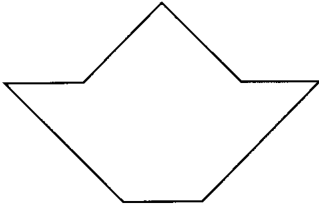
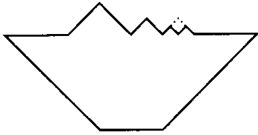
For such a polygon exists as shown by the figure.
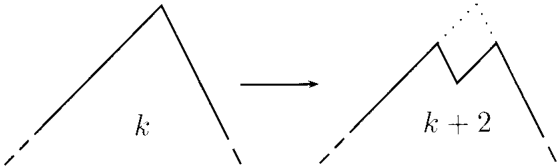
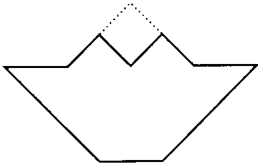
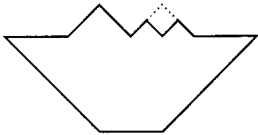
Let us prove by induction that for odd positive integers , , a polygon with the required property exists. Assume that for some integer a -gon with this property exists. Choose a vertex at which the inner angle is less than . Now, cut away a small parallelogram as shown in the figure. We obtain a -gon which has the required property. A few examples are shown in the figure below.
Want a route through all this instead of an archive? The track
puts 2,604 problems in a working order, from Junior Challenge level to the IMO shortlist.