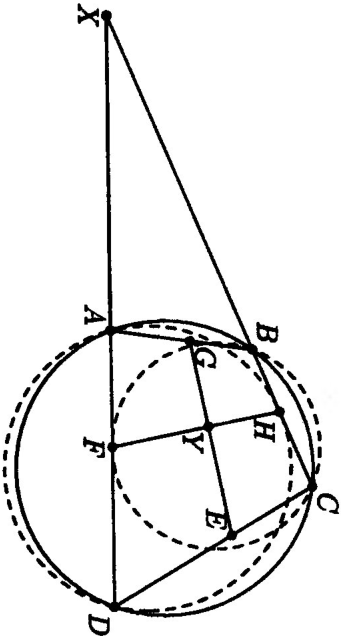
ABCD is a cyclic quadrilateral. Let the circle Γ1 pass through points A and B and touch CD at point E; let the circle Γ2 pass through points B and C and touch DA at point F; let the circle Γ3 pass through points C and D, and touch AB at point G; let at last the circle Γ4 pass through points D and A and touch BC at point H. Prove that EG⊥FH. (A. Voidelevich)
Solution
If the quadrilateral ABCD has the pair of parallel sides the result follows from the symmetry of the construction. So we suppose that ABCD is different from a trapezoid and a rectangle. Let X=BC∩AD. Since Γ2 touches AD at point F, we have XF2=XB⋅XC. Similarly, XH2=XA⋅XD. Since ABCD is cyclic, we have XB⋅XC=XA⋅XD, so XF=XH, and hence △XHF is an isosceles triangle. Thus ∠BHF=0.5(180∘−∠CXD)=0.5(∠C+∠D). Similarly, ∠BGE=0.5(∠A+∠D). Let GE∩HF=Y. Then △GYH=360∘−(∠B+0.5(∠C+∠D))+0.5(∠A+∠D))=360∘−(∠B+∠D)−0.5(∠A+∠C). Since ∠A+∠C=∠B+∠D=180∘, we have △GYH=360∘−180∘−90∘=90∘, so EG⊥FH.
Want a route through all this instead of an archive? The track
puts 2,604 problems in a working order, from Junior Challenge level to the IMO shortlist.
Source: MathNet,
licensed CC-BY-4.0.
Statement reproduced verbatim; metadata (topic, difficulty) added by this project.