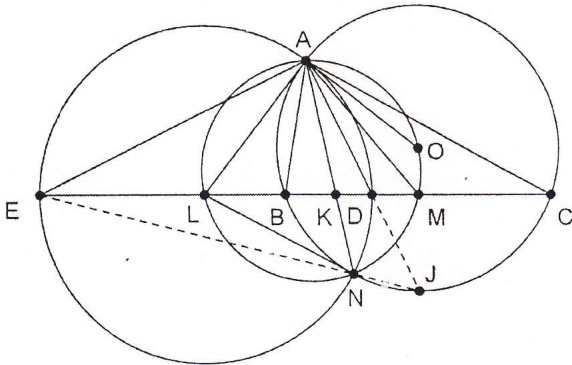
Let be a triangle and let be its circumcentre. The internal and external bisectrices of the angle meet the line at points and , respectively. Let further and respectively denote the midpoints of the segments and . The circles and meet again at point . Show that the angles and are equal.
ShortlistBMO, 2011
Solutions — 3
Solution 1
We must show that is symmedian in the triangle .
Let denote the radius of the circle and notice that the cross-ratio to deduce that , so and are antipodal in the circle . It then follows that is the reflection of in the diameter and lies on the Apollonius circle .
Let and meet at . We shall prove that is the symmedian through in the triangle . Notice that has equal powers relative to the circles and , , to deduce that
Finally, recall that
from the bisectrix theorem, to get
so , and conclude by Steiner's theorem that is indeed the symmedian from in the triangle .
Solution 2
As in the previous solution, is tangent to the circle , and is the reflection of in the diameter and lies on the Apollonius circle . It then follows that is the tangent at to the circle , so . On the other hand, , so .
Extend to meet again the circle at the midpoint of the arc that does not contain . Notice that is supplementary to to deduce, by the preceding, that lies on the diameter of the circle . The latter passes through , for the lines and are perpendicular. Consequently, and the conclusion follows.
Solution 3
We must show that is symmedian in the triangle .
Notice first that and are antipodal points on the circle , so is the reflection of about the diameter ; also, lies on the circle , for the lines and are perpendicular.
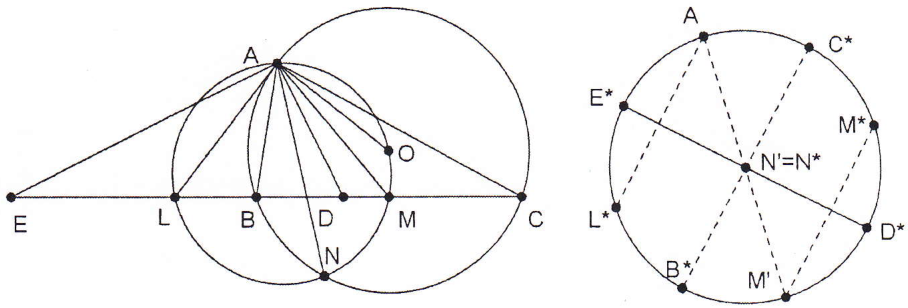
Now set the pole at and invert the configuration; write for the image of a point different from . The points and all lie on a circle through ; and are antipodal, for and are perpendicular; and are reflections of one another in the diameter , for and are the two bisectrices of the angle ; and the lines and are symmedians in triangles and , respectively, for and are medians in triangles and , respectively.
Since and are antipodal points on , the lines and are perpendicular, so is the reflection of in the diameter .
Let be the midpoint of the chord , extend to meet at and recall that is symmedian in triangle to deduce that is the reflection of in the diameter .
Consequently, the segments and are reflections of one another in the diameter , so lies on ; that is, is median in triangle .
Back to the original configuration, we conclude that is indeed symmedian in the triangle .
Want a route through all this instead of an archive? The track
puts 2,604 problems in a working order, from Junior Challenge level to the IMO shortlist.