A unit square is dissected into rectangles such that their sides are parallel to the sides of the square. Any line, parallel to a side of the square and intersecting its interior, also intersects the interior of some rectangle. Prove that in this dissection, there exists a rectangle having no point on the boundary of the square.
IMO Shortlist, 2007
Solutions — 2
Solution 1
Call the directions of the sides of the square horizontal and vertical. A horizontal or vertical line, which intersects the interior of the square but does not intersect the interior of any rectangle, will be called a splitting line. A rectangle having no point on the boundary of the square will be called an interior rectangle.
Suppose, to the contrary, that there exists a dissection of the square into more than one rectangle, such that no interior rectangle and no splitting line appear. Consider such a dissection with the least possible number of rectangles. Notice that this number of rectangles is greater than , otherwise their common side provides a splitting line.
If there exist two rectangles having a common side, then we can replace them by their union (see Figure 1).
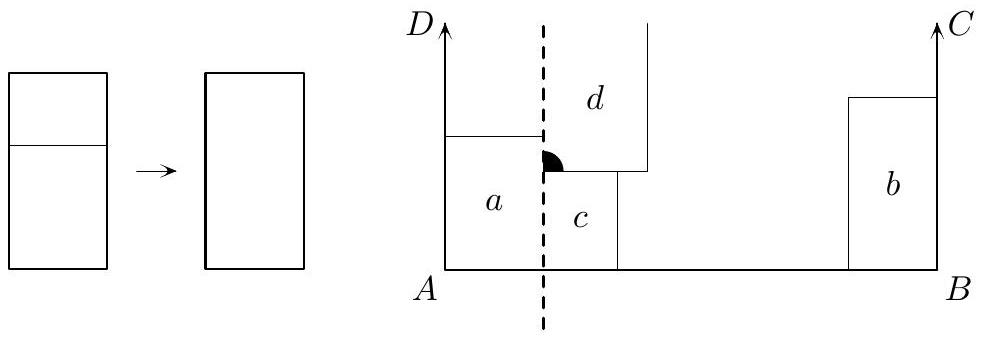
Figure 1
The number of rectangles was greater than , so in a new dissection it is greater than . Clearly, in the new dissection, there is also no splitting line as well as no interior rectangle. This contradicts the choice of the original dissection.
Denote the initial square by , with and being respectively the lower left and lower right vertices. Consider those two rectangles and containing vertices and , respectively. (Note that , otherwise its top side provides a splitting line.) We can assume that the height of is not greater than that of . Then consider the rectangle neighboring to the lower right corner of (it may happen that ). By aforementioned, the heights of and are distinct. Then two cases are possible.
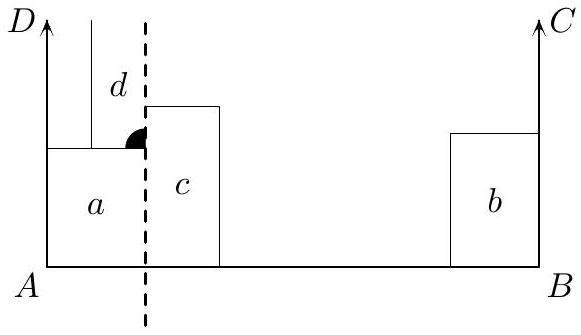
Figure 3
Case 1. The height of is less than that of . Consider the rectangle which is adjacent to both and , i.e. the one containing the angle marked in Figure 2. This rectangle has no common point with (since is not higher than ), as well as no common point with or with (obviously). Then has a common point with , and its left side provides a splitting line. Contradiction.
Case 2. The height of is greater than that of . Analogously, consider the rectangle containing the angle marked on Figure 3. It has no common point with (otherwise it has a common side with ), as well as no common point with or with (obviously). Then has a common point with . Hence its right side provides a splitting line, and we get the contradiction again.
Solution 2
Again, we suppose the contrary. Consider an arbitrary counterexample. Then we know that each rectangle is attached to at least one side of the square. Observe that a rectangle cannot be attached to two opposite sides, otherwise one of its sides lies on a splitting line.
We say that two rectangles are opposite if they are attached to opposite sides of . We claim that there exist two opposite rectangles having a common point.
Consider the union of all rectangles attached to the left. Assume, to the contrary, that has no common point with the rectangles attached to the right. Take a polygonal line connecting the top and the bottom sides of the square and passing close from the right to the boundary of (see Figure 4). Then all its points belong to the rectangles attached either to the top or to the bottom. Moreover, the upper end-point of belongs to a rectangle attached to the top, and the lower one belongs to another rectangle attached to the bottom. Hence, there is a point on where some rectangles attached to the top and to the bottom meet each other. So, there always exists a pair of neighboring opposite rectangles.
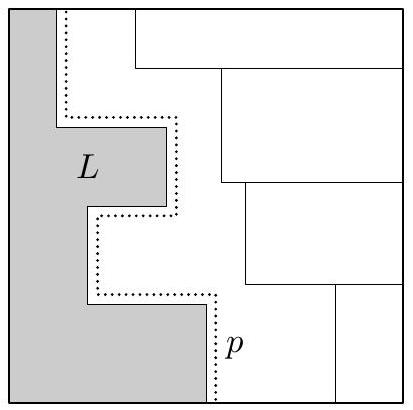
Figure 4
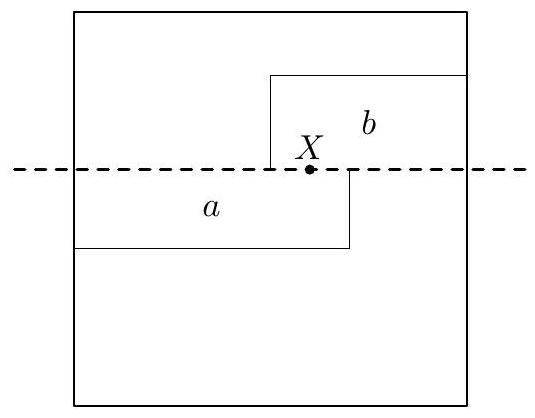
Figure 5
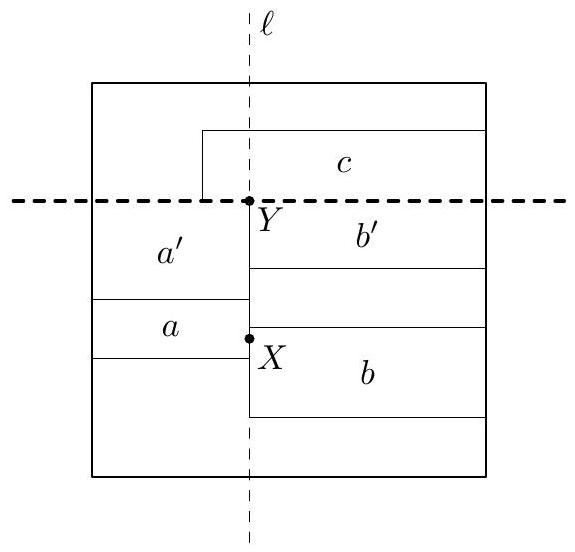
Figure 6
Now, take two opposite neighboring rectangles and . We can assume that is attached to the left and is attached to the right. Let be their common point. If belongs to their horizontal sides (in particular, may appear to be a common vertex of and ), then these sides provide a splitting line (see Figure 5). Otherwise, lies on the vertical sides. Let be the line containing these sides.
Since is not a splitting line, it intersects the interior of some rectangle. Let be such a rectangle, closest to ; we can assume that lies above . Let be the common point of and the bottom side of (see Figure 6). Then is also a vertex of two rectangles lying below .
So, let be the upper-right and upper-left corners of the rectangles and , respectively. Then and are situated not lower than and , respectively (it may happen that or ). We claim that is attached to the left. If then of course it is. If then is above , below and to the left from . Hence, it can be attached to the left only.
Analogously, is attached to the right. Now, the top sides of these two rectangles pass through , hence they provide a splitting line again. This last contradiction completes the proof.
Want a route through all this instead of an archive? The track
puts 2,604 problems in a working order, from Junior Challenge level to the IMO shortlist.