Define a hook to be a figure made up of six unit squares as shown in the diagram or any of the figures obtained by applying rotations and reflections to this figure.
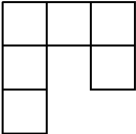
Determine all rectangles that can be covered with hooks so that
* the rectangle is covered without gaps and without overlaps;
* no part of a hook covers area outside the rectangle.
International Mathematical Olympiad
Solutions — 2
Solution 1
and should be the positive integers and should satisfy one of the following conditions:
(1) and (or vice versa);
(2) one of and is divisible by and one is not less than .
A figure is obtained by applying rotations and reflections to another figure. We regard the two figures as equivalent.
Label the six unit squares of the hook as shown below. The shaded square must belong to another hook, and it is adjacent to only one square of this other hook. Then the only possibility of the shaded square is or .
(i) If it is , two hooks form a rectangle. We call it .
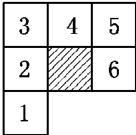
(ii) If it is , there are two cases.
It is easy to see that the shaded square cannot be covered in the first diagram as shown below. Hence the latter is true. We call it .
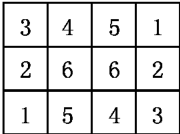
Thus, in a tessellation, all hooks are matched into pairs. Each pair forms or .
There are squares in and . Hence .
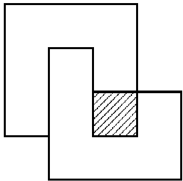
Now we consider three cases, separately.
(1) and (or vice versa)
Without loss of generality, we may assume and .
Then rectangles of the type form an rectangle. Since two hooks cover a rectangle, an rectangle can be covered with hooks.
(2) or . Without loss of generality, we may assume .
If or , the question reduces to (1).
Assume that is not divisible by nor by . If a tessellation exists, then there is at least one of and in it, so . Hence because and . Since the square at the corners can belong to either or , it follows from that the squares at the adjacent corners cannot belong to the same type or . Hence . Since is not divisible by and , .
(3) , but neither nor is divisible by . Now , . We may assume without loss of generality that , , neither nor is divisible by . We will prove that if these conditions are satisfied, an rectangle cannot be covered with hooks.
Consider coloring the columns of an matrix with black and white colors alternately. Then the number of the black squares equals that of the white ones. One always covers black squares. A horizontal always covers black squares. A vertical covers either black squares and white ones, or black squares and white ones. Since the number of the black squares equals that of the white ones, the number of is the same in the preceding two cases. Hence the total number of a vertical is even. Using the same argument as above (coloring the rows alternately), we obtain that the total number of a horizontal is even.
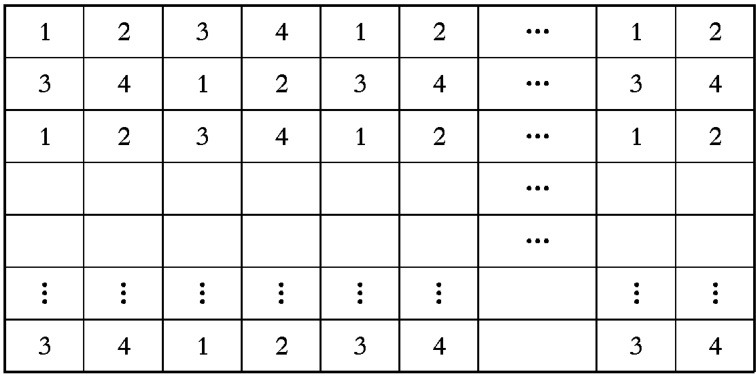
Consider classifying the squares of the rectangle into types marked , , , and as shown below. The number of squares of each type is equal to .
From the two diagrams,
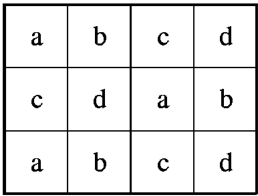
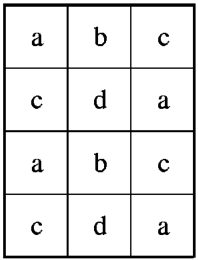
we obtain that the number of and covered by is the same, so is for and . Hence the number of squares of type covered by equals that of type .
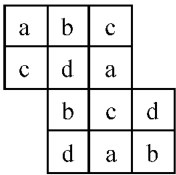
(i)
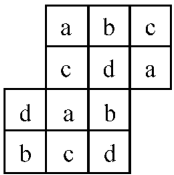
(ii)
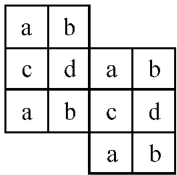
(iii)
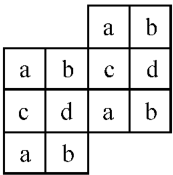
(iv)
The number of squares of type covered by (i) or (ii) equals that of type . The difference between the number of squares of type and type covered by (iii) or (iv) is . There are two cases; the number of squares of type is more than that of type , or vice versa. Since the number of squares of type equals that of type in the rectangle, the frequency of the two cases is the same. Hence the total number of (iii) and (iv) is even.
Similarly, the total number of (i) and (ii) is even. Then the number of is even. So there is an even number of and . Hence , contrary to the assumption that neither nor is divisible by .
We now show that if and is not divisible by and , a tessellation exists.
If , then (). Together with (1), we have that if , an rectangle and an rectangle can be covered with hooks. So the problem can be solved.
If , (). Together with (1), we have that if , each of and rectangles can be covered with hooks. The problem is solved.
Solution 2
and should be the positive integers and should satisfy one of the following conditions:
(1) and (or vice versa);
(2) , (or vice versa).
Consider a covering of an rectangle satisfying the conditions. For any hook , there is a unique hook covering the "inner" square of with one of its "tailend" squares. In turn, the "inner" square of must be covered by a "tailend" square of . Thus, in a tessellation, all hooks are matched into pairs. There are only two possibilities to place so that it does not overlap with and no gap occurs. In one case, and form a rectangle; in the other, their union is an octagonal shape, with sides of length , , , , , , , respectively.
So an rectangle can be covered with hooks if and only if it can be covered with the -square tiles described above. Suppose that such a tessellation exists; then is divisible by . We now show that one of and is divisible by .
Assume on the contrary that this is not the case. Then and are both even, because is divisible by . Imagine that the rectangle is divided into unit squares, with the rows and columns labeled and . Write in the square if exactly one of and is divisible by , and , if and are both divisible by . Since the number of squares in each row and column is even, the sum of all numbers written is also even. Now, it is easy to check that a rectangle always covers numbers with sum or ; and the other -square shape always covers numbers with sum or . Consequently, the total number of -square shapes is even. But then is divisible by , and hence by , contrary to the assumption that and are not divisible by .
Notice also that neither nor can be , or (any attempt to place tiles along a side of length , or fails). We infer that if a tessellation is possible, then one of and is divisible by , one is divisible by , and .
Conversely, we shall prove that if these conditions are satisfied, then a tessellation is possible (using only rectangles). The result is immediate if divides and divides (or vice versa). Let be divisible by and (or vice versa). Without loss of generality, we may assume that neither nor divides . Then . In addition, between and , at least one can be divisible by . Hence the rectangle can be partitioned into and rectangles, which are easy to cover, in fact with only tiles again.
Want a route through all this instead of an archive? The track
puts 2,604 problems in a working order, from Junior Challenge level to the IMO shortlist.