Maths Olympiad Prep

Library / /18 of 39

Geometry Difficulty 6.0 National olympiad Prove it Romania

Let ABCABC be a triangle with BAC=40\angle BAC = 40^\circ and ABC=80\angle ABC = 80^\circ. Denote II its incircle. Prove that AI=BCAI = BC.

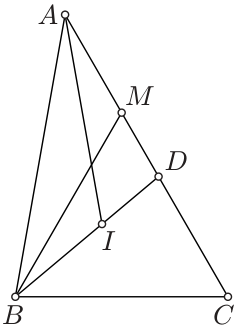
Figure 1

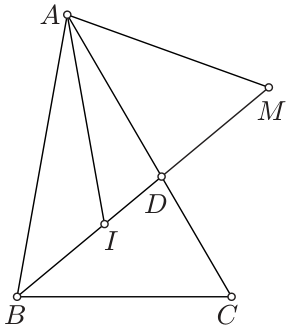
Figure 2

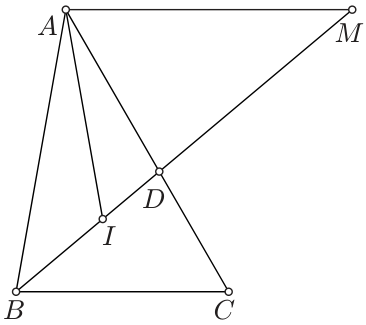
Figure 3

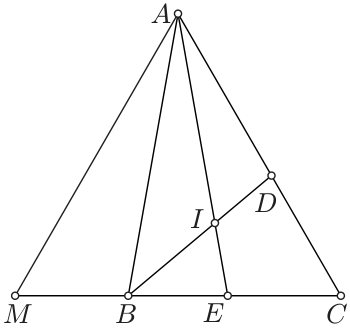
Figure 4

Solution

Let {D}=BIAC\{D\} = BI \cap AC. Then BAD=ABD=40\angle BAD = \angle ABD = 40^\circ, so ABD\triangle ABD is isosceles, yielding AD=BDAD = BD (1).

First construction. Draw the bisector BMBM of DBA\angle DBA, with MACM \in AC. Then ABM=IAB=20\angle ABM = \angle IAB = 20^\circ and ABAB is a common side, hence IABMBA\triangle IAB \equiv \triangle MBA (A.S.A.), whence AI=BMAI = BM.

Then relations CBM=CBD+DBM=60\angle CBM = \angle CBD + \angle DBM = 60^\circ and MCB=60\angle MCB = 60^\circ show that triangle MBCMBC is equilateral, therefore BC=BM=AIBC = BM = AI.

Second construction. Take the equilateral triangle AMI\triangle AMI, D(IM)D \in (IM). Since MAD=MAIIAD=6020=40\angle MAD = \angle MAI - \angle IAD = 60^\circ - 20^\circ = 40^\circ, MAD=DBC\angle MAD = \angle DBC (2). From (1), (2) and AMD=DCB=60\angle AMD = \angle DCB = 60^\circ follows ADMBDC\triangle ADM \equiv \triangle BDC (A.S.A.), whence AM=BCAM = BC. Now AMI\triangle AMI equilateral implies AI=AMAI = AM, hence AI=BCAI = BC.

Third construction. Let AMBCAM \parallel BC, MBIM \in BI. Then AMB=MBC\angle AMB = \angle MBC (alternate angles), implying ABM=AMB=40\angle ABM = \angle AMB = 40^\circ, hence ABM\triangle ABM is isosceles, whence AB=AMAB = AM (3). From CAM=ACB=60\angle CAM = \angle ACB = 60^\circ (alternate angles) follows IAM=20+60=80=ABC\angle IAM = 20^\circ + 60^\circ = 80^\circ = \angle ABC (4). Relations (3), (4) and AMI=BAC=40\angle AMI = \angle BAC = 40^\circ give AMIBAC\triangle AMI \equiv \triangle BAC (A.S.A.), which implies AI=BCAI = BC.

Fourth construction. Take MM so that B(MC)B \in (MC) and ACM\triangle ACM is equilateral. Then relations CA=CMCA = CM, ICA=ICM=30\angle ICA = \angle ICM = 30^\circ and ICIC common side lead to CIACIM\triangle CIA \equiv \triangle CIM (S.A.S.), whence IA=IMIA = IM (5) and IAC=IMC=20\angle IAC = \angle IMC = 20^\circ.

Let {E}=AIBC\{E\} = AI \cap BC. From MAB=MACBAC=20\angle MAB = \angle MAC - \angle BAC = 20^\circ, AM=MCAM = MC and AMB=ACE=60\angle AMB = \angle ACE = 60^\circ follows MABCAE\triangle MAB \equiv \triangle CAE (A.S.A.), hence MB=ECMB = EC, which implies ME=BCME = BC (6). From AEM\triangle AEM, AEM=1806040=80\angle AEM = 180^\circ - 60^\circ - 40^\circ = 80^\circ, so, in MIE\triangle MIE, MIE=1802080=80=MEI\angle MIE = 180^\circ - 20^\circ - 80^\circ = 80^\circ = \angle MEI, hence MIE\triangle MIE is isosceles, whence MI=MEMI = ME (7). Relations (5), (6) and (7) yield IA=IM=ME=BCIA = IM = ME = BC.

Want a route through all this instead of an archive? The track puts 2,000 problems in a working order, from AMC 10 level to the IMO shortlist.

Source: MathNet, licensed CC-BY-4.0. Statement and solution reproduced as published; topic and difficulty added by this site.