Given a white 6×2019 table. Andrii and Arsenii are playing the following game: one after another (starting with Andrii) a player colors one of the 1×1 cells in black. Moreover, one's turn cannot create a 3×3 square that contains two black cells. Whoever doesn't have a turn loses. Who will win if both want to win the game? And what is the strategy?
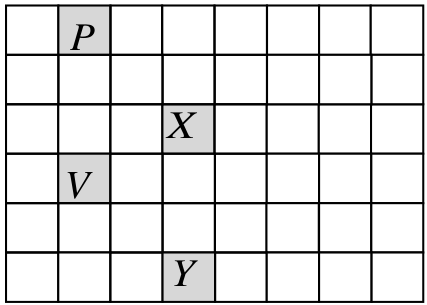
Fig. 3
Solution
We will show that there exists a strategy such that Arsenii always has a turn after Andrii's turn. We will split all the cells into friendly pairs. Two 1×1 cells make a friendly pair, if they are in the same column and there are exactly two 1×1 cells in-between. Then Arsenii colors the cell that makes a friendly pair with a cell that Andrii colored during his last turn.
We want to show that Arsenii always has such a turn. If Andrii colored some cell P, then a cell V, that makes a friendly pair with P is white. Moreover, suppose the cell V cannot be colored in black because there already is another black cell Y in some 3×3 square that is located either in the very top or the very bottom of the table. Then there also exists another similar 3×3 square either in the very top or the very bottom that contains cells P and Y, both of which are black, where Y is a friendly pair of V (Fig. 3). This completes the proof.
Want a route through all this instead of an archive? The track
puts 2,604 problems in a working order, from Junior Challenge level to the IMO shortlist.
Source: MathNet,
licensed CC-BY-4.0.
Statement reproduced verbatim; metadata (topic, difficulty) added by this project.