Answer: 316.
Let A(a;1/a), B(b;1/b), C(c;1/c), D(d;1/d) be the marked points (see Fig. 1). Since any vertical and any horizontal line meets the hyperbola y=1/x at most at one point we see that the numbers a, b, c, d are pairwise distinct. Since the opposite sides of the parallelogram are equal, we have
AB=CD⟺(b−a)2+(1/b−1/a)2=(d−c)2+(1/d−1/c)2 ⟺(b−a)2(1+(ab)21)=(d−c)2(1+(cd)21).(1)
Moreover, since opposite sides of the parallelogram are equal and parallel we see that their projections on any line are equal, in particular, their projections on Ox-axis are equal, i.e. ∣b−a∣=∣d−c∣. Then from (1) it follows that
1+a2b21=1+c2d21⟹a2b2=c2d2.
Similarly, from BC=AD we obtain b2c2=a2d2. Therefore, a2=c2 and b2=d2, and so, taking into consideration a=c and b=d, we obtain a=−c, d=−b. Without loss of generality we suppose that a<0<b, and then b<c. Since AB=2BC we have
(b+c)2(1+(bc)21)=(b−a)2(1+(ab)21)=AB2=(2BC)2=
=4(c−b)2(1+(bc)21),
so (b+c)2=4(b−c)2. Then b+c=2(c−b), so we have c=3b.
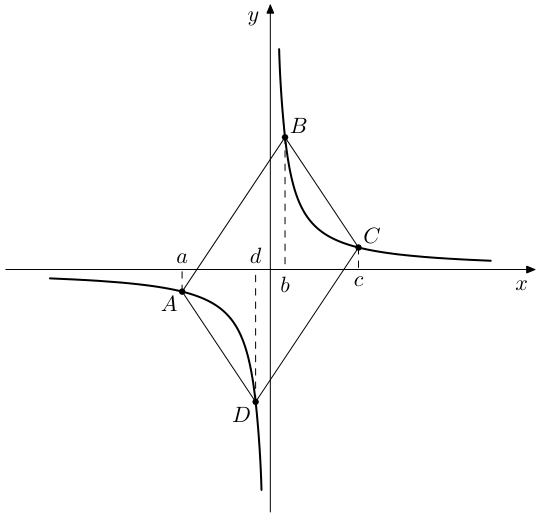
Fig. 1
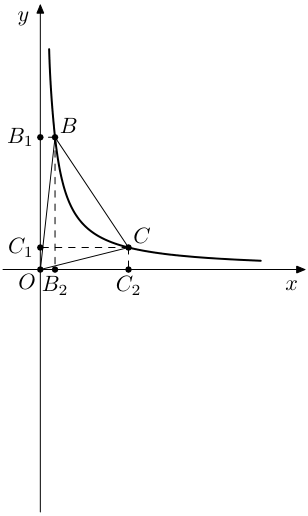
Fig. 2
Consider the pentagon B1BCC2O (see Fig. 2). Since B1(0,1/b), B2(b,0), C1(0,1/c), C2(c,0) we have
S(B1BCC2O)=S(B1BB2O)+S(BCC2B2)=b⋅b1+21/b+1/c⋅(c−b)==[c=3b]=1+3b4⋅21⋅2b=37.
On the other hand,
S(B1BCC2O)=S(OB1B)+S(OBC)+S(OCC2)==21⋅b1⋅b+S(OBC)+21⋅c1⋅c=1+S(OBC),
so S(OBC)=34. Since S(ABCD)=4S(OBC) the required area of the parallelogram ABCD is equal 316.