Determine all real numbers between and such that it is possible to partition an equilateral triangle into finitely many triangles, each of which has an angle of .
Singapore Mathematical Olympiad (SMO)
Solution
Consider the sum of the angles of the triangles at each type of the vertices. At type 0, the sum is . At type 1, the sum is . At type 2, the sum is . Therefore
Now each Type 1 vertex has at most 1 angle of and each Type 2 vertex has at most 2 which each Type 0 vertex has, none. So the number of angles of is , a contradiction.
Now we construct for each . It is trivial for . Take the centre of the triangle and join it to the vertices to obtain a partition into 3 congruent triangles. Now assume .
Define an -trapezium to be the trapezium with , , . Then it follows that . We call a polygon -good if it can be partitioned into triangles each with one angle.
Lemma 1: There exists such that an -trapezium is -good when .
Proof: The proof is clear from Fig. A. The second, third and fourth triangles are isosceles. The fifth and sixth triangles form a parallelogram with arbitrarily long horizontal side.
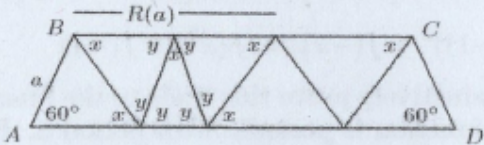
Fig.A
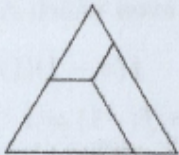
Fig.B
Lemma 2: An -trapezium is -good.
Proof: It follows from the fact that the trapezium can be sliced into arbitrarily thin -trapezium so that . (See Fig. B.)
Since an equilateral triangle can be partitioned in -trapeziums, the proof is complete.
Want a route through all this instead of an archive? The track
puts 2,604 problems in a working order, from Junior Challenge level to the IMO shortlist.