Given two hyperbolae and with the equations and , respectively. A straight line meets at points and , and meets at points and . The lines tangent to at points and intersect at point , and the lines tangent to at points and intersect at point .
Prove that and are symmetric with respect to the origin of coordinates.
Belarus — Final Round
Solution
Without loss of generality we may assume that the positions of all hyperbolae, lines, and points look like in the figure (otherwise we can rotate the plane by the angle which is a multiple of , and rename the points).
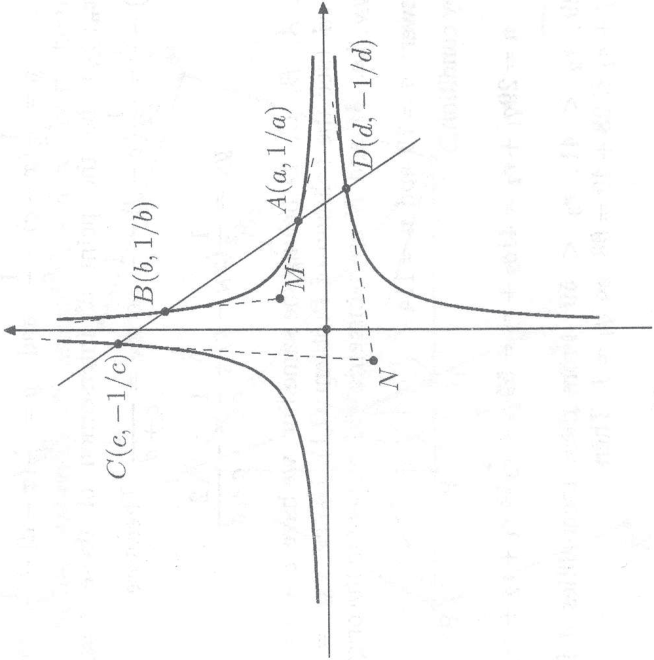
Let , , , . Note that all numbers , , , are pairwise distinct and , . Since the derivative of the function is equal to , the equations of the tangents to at and have the forms
Let be the point of intersection of these tangents, then
Similarly, since the derivative of the function is equal to , the equations of the tangents to at and have the forms
Let be the point of intersection of these tangents, then
Since , , , belong to the same line, we have and (see the solution of Problem C.1). Hence and , i.e., and are symmetric with respect to the origin.
Want a route through all this instead of an archive? The track
puts 2,604 problems in a working order, from Junior Challenge level to the IMO shortlist.