Let be the intersection point of the diagonals of inscribed quadrilateral . Points and are marked on the bisectors of and , respectively, so that and . Let be the intersection point of the lines and , and be the intersection point of the lines and .
Prove that the lines and are perpendicular.
(D. Pirshtuk)
Belarusian Mathematical Olympiad
Solution
Let . Then since the triangles and are isosceles. Therefore, .
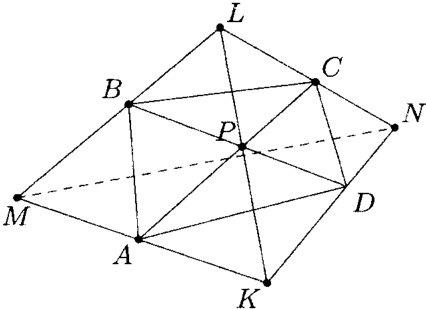
From the equalities , and the power of a point theorem it follows that . Hence, . Further, . Therefore, the triangles , are similar, so . Hence, .
Now we have and . It follows that and lie on the perpendicular bisector of the segment , which gives the required statement.
Want a route through all this instead of an archive? The track
puts 2,604 problems in a working order, from Junior Challenge level to the IMO shortlist.