Maths Olympiad Prep

Library / /76 of 101

Geometry Difficulty 6.8 National olympiad Prove it Estonia

An acute angle with vertex AA and size α\alpha is given on a plane. Points B0B_0 and B1B_1 are chosen on different sides of the angle in such a way that AB0B1=β\angle AB_0B_1 = \beta. Whenever points B0,B1,,Bn1B_0, B_1, \dots, B_{n-1} are defined, the next point BnB_n on side ABn2AB_{n-2} is allowed to be defined in such a way that BnBn2B_n \neq B_{n-2} and Bn1Bn=Bn2Bn1B_{n-1}B_n = B_{n-2}B_{n-1}. Prove that this process cannot last infinitely and determine the largest index nn (depending on α\alpha and β\beta) for which BnB_n can be defined.

Solution

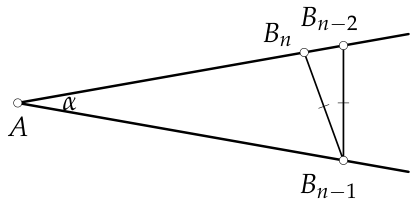
Let BnB_n for some n>1n > 1 be definable (Fig. 30). By construction, AA, Bn2B_{n-2}, and BnB_n are collinear, whereby AA cannot lie between Bn2B_{n-2} and BnB_n. Since Bn1Bn2=Bn1BnB_{n-1}B_{n-2} = B_{n-1}B_n and Bn2BnB_{n-2} \neq B_n, the triangle Bn2Bn1BnB_{n-2}B_{n-1}B_n is isosceles, so that ABn2Bn1+ABnBn1=180\angle AB_{n-2}B_{n-1} + \angle AB_nB_{n-1} = 180^\circ and ABn2Bn190\angle AB_{n-2}B_{n-1} \neq 90^\circ. Consequently,
Figure 1

Fig. 30

ABn1Bn=180αABnBn1=180α(180ABn2Bn1)=ABn2Bn1α\angle AB_{n-1}B_n = 180^\circ - \alpha - \angle AB_nB_{n-1} = 180^\circ - \alpha - (180^\circ - \angle AB_{n-2}B_{n-1}) = \angle AB_{n-2}B_{n-1} - \alpha. Since AB0B1=β\angle AB_0B_1 = \beta, by induction we get ABn1Bn=β(n1)α\angle AB_{n-1}B_n = \beta - (n-1)\alpha. Hence defining of BnB_n assumes that β(n2)α90\beta - (n-2)\alpha \neq 90^\circ and β(n1)α0\beta - (n-1)\alpha \ge 0^\circ. These conditions are also sufficient, because if β(n2)α90\beta - (n-2)\alpha \neq 90^\circ, meaning that ABn2Bn190\angle AB_{n-2}B_{n-1} \neq 90^\circ, then point BnB_n can be chosen different from Bn2B_{n-2} on the line ABn2AB_{n-2}, and if β(n1)α0\beta - (n-1)\alpha \ge 0^\circ, meaning that ABn2Bn1α\angle AB_{n-2}B_{n-1} \ge \alpha, then this point is located on the side ABn2AB_{n-2}.

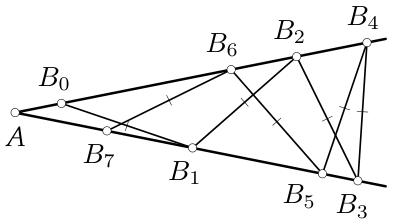
Summing up, the largest nn for which BnB_n is definable equals β90α+1\frac{\beta-90^\circ}{\alpha} + 1 if β(n2)α=90\beta - (n-2)\alpha = 90^\circ for some integer n>1n > 1, or equivalently, β90α\frac{\beta-90^\circ}{\alpha} is a non-negative integer, and βα+1\lfloor \frac{\beta}{\alpha} \rfloor + 1 otherwise. Figures 31 and 32 depict the situation in the first and second case, respectively.
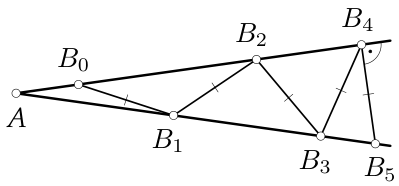
Figure 2
Fig. 31

Figure 3
Fig. 32

Want a route through all this instead of an archive? The track puts 2,000 problems in a working order, from AMC 10 level to the IMO shortlist.

Source: MathNet, licensed CC-BY-4.0. Statement and solution reproduced as published; topic and difficulty added by this site.