In the Cartesian coordinate plane define the strip for every integer . Assume that each strip is colored either red or blue, and let and be two distinct positive integers. Prove that there exists a rectangle with side lengths and such that its vertices have the same color.
IMO Shortlist, 2007
Solution
If and have the same color for some integer , then we can choose the rectangle with vertices , and , and we are done. So it can be assumed that and have opposite colors for each .
Similarly, it also can be assumed that and have opposite colors. Then, by induction on , we obtain that for arbitrary integers and , strips and have the same color if is even, and these two strips have opposite colors if is odd.
Let , and . Apply the result above for and . The strips and are identical and therefore they have the same color. Hence, is even. By the construction, and are coprime, so this is possible only if both are odd.
Without loss of generality, we can assume . Then , so .
Choose integers and such that and therefore . Since and are odd, is odd as well. Hence, for every integer , strips and have opposite colors. This also implies that the coloring is periodic with period , i.e. strips and have the same color for every .
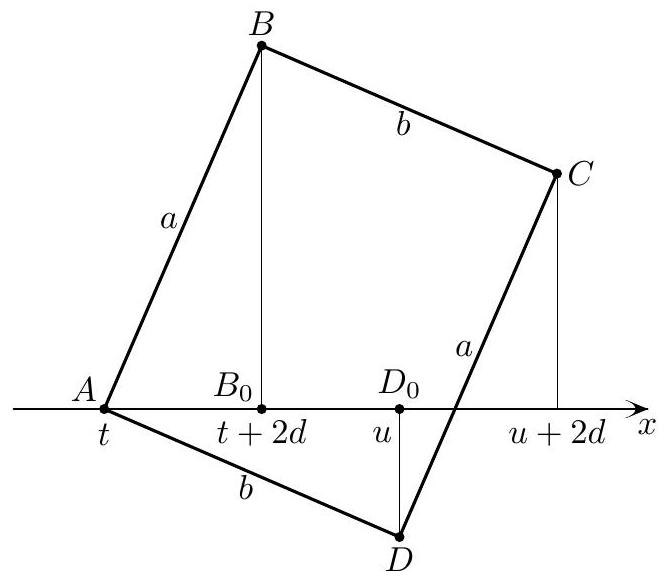
Figure 1
We will construct the desired rectangle with and in a position such that vertex lies on the -axis, and the projection of side onto the -axis is of length (see Figure 1). This is possible since . The coordinates of the vertices will have the forms
Let . By Pythagoras' theorem,
So, by the similar triangles and , we have the constraint
for numbers and . Computing the numbers and is not required since they have no effect to the colors.
Observe that the number is irrational, because is an integer, but is not: .
By the periodicity, points and have the same color; similarly, points and have the same color. Furthermore, these colors depend only on the values of and . So it is sufficient to choose numbers and such that vertices and have the same color.
Let be the largest positive integer such that there exist consecutive strips with the same color, say red. (Since must be blue, we have .) We will choose from the interval .
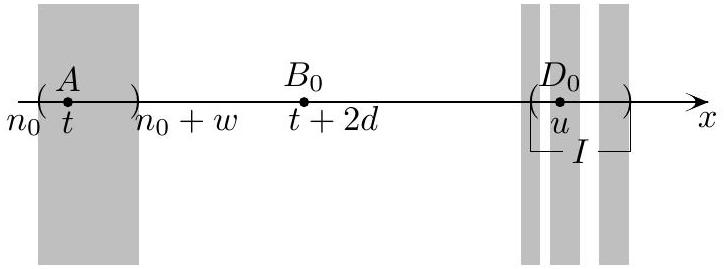
Figure 2
Consider the interval on the -axis (see Figure 2). Its length is , and the end-points are irrational. Therefore, this interval intersects consecutive strips. Since at most consecutive strips may have the same color, interval must contain both red and blue points. Choose such that the line is red and set , according to the constraint (1). Then and is red as well as .
Hence, variables and can be set such that they provide a rectangle with four red vertices.
Want a route through all this instead of an archive? The track
puts 2,604 problems in a working order, from Junior Challenge level to the IMO shortlist.