Maths Olympiad Prep

Library / China Southeastern Mathematical Olympiad /17 of 39

China Southeastern Mathematical Olympiad

Geometry Difficulty 5.9 AIME, harder Prove it China

Suppose that a line passing the circumcentre OO of △ABC\triangle ABC intersects ABAB and ACAC at points MM and NN, respectively, and EE and FF are the midpoints of BNBN and CMCM, respectively. Prove that ∠EOF=∠A\angle EOF = \angle A. (posed by Tao Pingsheng)

Solution

We show that the above conclusion is true for any triangle.

If △ABC\triangle ABC is right-angled. The conclusion is obvious. In fact, see Fig. 4. 1, where ∠ABC=90∘\angle ABC = 90^\circ. So, the circumcentre OO is the midpoint of ACAC, OA=OBOA = OB and N=ON = O. Since FF is the midpoint of CMCM, we see that the median line OF∥AMOF \parallel AM. Hence ∠EOF=∠OBA=∠OAB=∠A\angle EOF = \angle OBA = \angle OAB = \angle A.

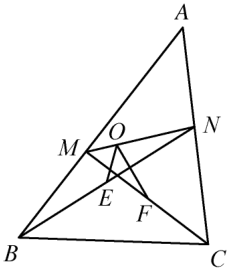
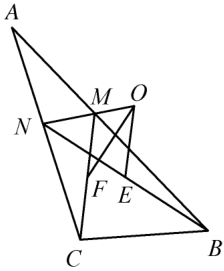
If △ABC\triangle ABC is not right-angled, see Fig. 4. 2 and Fig. 4. 3.
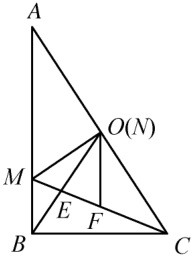
Figure 1
Fig. 4. 1
Figure 2
Fig. 4. 2
Figure 3
Fig. 4. 3

First we give a lemma.

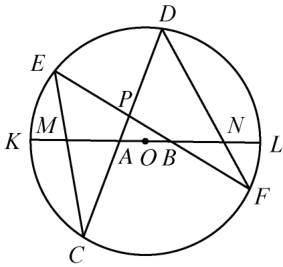
Lemma. Let AA and BB be two points on the diameter KLKL of circle ⊙O\odot O with radius RR, and OA=OB=aOA = OB = a. See figure.
Let CDCD and EFEF be two chords passing AA and BB, respectively. Suppose CECE and DFDF intersect KLKL at MM and NN, respectively. Then MA=NBMA = NB.

Proof of the lemma. As shown in Fig. 4. 4. Suppose that CD∩EF=PCD \cap EF = P. Think of that lines CECE and DFDF intersect △PAB\triangle PAB. By Menelaus' Theorem, we have
Figure 4
Fig. 4. 4
ACCP⋅PEEB⋅BMMA=1, \frac{AC}{CP} \cdot \frac{PE}{EB} \cdot \frac{BM}{MA} = 1,
BFFP⋅PDDA⋅ANNB=1. \frac{BF}{FP} \cdot \frac{PD}{DA} \cdot \frac{AN}{NB} = 1.
Then
MANB=ACBE⋅ADBF⋅PEPC⋅PFPD⋅BMAN.1◯ \frac{MA}{NB} = \frac{AC}{BE} \cdot \frac{AD}{BF} \cdot \frac{PE}{PC} \cdot \frac{PF}{PD} \cdot \frac{BM}{AN}. \qquad \textcircled{1}
By the Intersecting Chord Theorem, we get
PC⋅PD=PE⋅PF.2◯ PC \cdot PD = PE \cdot PF. \qquad \textcircled{2}
So
AC⋅AD=AK⋅AL=R2−a2=BK⋅BL=BE⋅BF.3◯ AC \cdot AD = AK \cdot AL = R^2 - a^2 = BK \cdot BL = BE \cdot BF. \qquad \textcircled{3}
By ①, ③, we have MANB=MBNA\frac{MA}{NB} = \frac{MB}{NA}, that is
MANB=MA+ABNB+AB=ABAN=1. \frac{MA}{NB} = \frac{MA + AB}{NB + AB} = \frac{AB}{AN} = 1.
Thus, MA=NBMA = NB.

Want a route through all this instead of an archive? The track puts 2,604 problems in a working order, from Junior Challenge level to the IMO shortlist.

Source: MathNet, licensed CC-BY-4.0. Statement reproduced verbatim; metadata (topic, difficulty) added by this project.