The distance between two circles ω and ω′ is defined as the length of their common external tangent and is represented as d(ω,ω′). If two circles don't have a common external tangent, the distance between them is not defined. Also, note that a point is a circle with zero radius and that the distance between two circles can be zero.
a) Centroid. Circles ω1,ω2,...,ωn are given in the plane where n is a natural number. Prove that a unique circle ωˉ exists such that for an arbitrary circle ω in that plane, the difference between the square of the distance between ω and ωˉ and the average of the squares of the distances between ω and ωi (1≤i≤n) is constant (for those circles ω that all these distances are defined). That is, ∀ω:d(ω,ωˉ)2−n1i=1∑nd(ω,ωi)2=constant. ωˉ is called the centroid of these circles, for it is similar to the centroid of n points in the plane.
b) Perpendicular bisector. Suppose that circle ω is equidistant from circles ω1 and ω2. Let ω3 be an arbitrary circle whose center is on the centerline of circles ω1 and ω2 and is tangent to the common external tangent of circles ω1 and ω2. Prove that "the distance between ω and the centroid of circles ω1 and ω2" is not more than "the distance between ω and ω3" (for the case that all these distances are defined).
c) Circumcenter. Let C be the set of all circles in the plane that each one of them is equidistant from three fixed circles ω1,ω2 and ω3. Prove that a fixed point exists in the plane that is the direct homothetic center of each two circles in C.
d) Regular tetrahedron. Do there exist four circles in the plane for which the distance between any two of them is unity?
150 minutes (→ p.34)
Solution
Denote by C(O,R) the circle with center O and radius R. If ω1=C(O1,R1) and ω2=C(O2,R2), then d(ω1,ω2)2=O1O22−(R1−R2)2, and d(ω1,ω2) is defined if and only if the right hand side is nonnegative. This is equivalent to the existence of the common external tangents of these circles.
a) Let ω=C(O,R) and ωi=C(Oi,Ri) for 1≤i≤n. We have n1i=1∑nd(ω,ωi)2=n1i=1∑nOOi2+n1i=1∑n(R−Ri)2. Suppose that Rˉ=n1(R1+R2+⋯+Rn). Then n1i=1∑n(R−Ri)2=R2−2RRˉ+n1i=1∑nRi2=(R−Rˉ)2+n1i=1∑n(Rˉ−Ri)2. Similarly, let Oˉ be the centroid of all the Oi's (1≤i≤n). Then n1i=1∑nOOi2=OOˉ2+n1i=1∑nOˉOi2. Therefore, the circle C(Oˉ,Rˉ) satisfies the problems condition. Now, if two circles ωˉ1=C(P1,r1) and ωˉ2=C(P2,r2) both satisfy the problems condition, for each circle ω we can write (C is a constant value here): d(ω,ωˉ1)2−d(ω,ωˉ2)2⇒⇒=COP12−OP22+(R−r1)2−(R−r2)2=COP12−OP22−2R(r1−r2)=C By fixing O, we have r1=r2 and hence OP12−OP22 is a constant value. Thus P1=P2 and ωˉ1=ωˉ2. Therefore, ωˉ=C(Oˉ,Rˉ) is the unique circle satisfying the problems condition.
b) We can write x3=(1−α)x1+αx2 for some α∈R. Since the distances of O1 and O2 from the common tangent are R1 and R2, respectively, we conclude that the distance of O3 from this line is ∣(1−α)R1+αR2∣ (If the number in the absolute value sign is negative, it means that O1 and O2 are in the two sides of that line). So R3=∣(1−α)R1+αR2∣. Furthermore, the centroid of ω1 and ω2 is ωˉ=C(2x1+x2,2R1+R2). Therefore, putting α=21 in the definition of ω3 implies d(ω,ω1)=d(ω,ω2)⇒OO12−(R−R1)2=OO22−(R−R2)2⇒OO12−OO22=R12−R22−2R(R1−R2)⇒(x−x1)2−(x−x2)2=R12−R22−2R(R1−R2)⇒2x(x1−x2)−2R(R1−R2)=x12−x22−R12+R22. We have d(ω,ω3)2=(x−x3)2+y2−(R−R3)2=(x−((1−α)x1+αx2))2+y2−(R−((1−α)R1+αR2))2=((x−x1)+α(x1−x2))2+y2−((R−R1)+α(R1−R2))2. Suppose that circles ω, ω1 and ω2 are fixed and α varies. We can write d(ω,ω3)2 as a polynomial of α such as p2α2+p1α+p0. We know p2=(x1−x2)2−(R1−R2)2 is nonnegative because d(ω1,ω2) is defined. Furthermore, the coefficient of α is p1=2(x1−x2)(x−x1)−2(R1−R2)(R−R1). Because of the relation between X and R, x12−R12−x22+R22−2x1(x1−x2)+2R1(R1−R2)=−(x1−x2)2+(R1−R2)2. If p1=p2=0, d(ω,ω3) is independent of α. Otherwise, the minimum value of d(ω,ω3) is for α=21 and the assertion is proved.
c) First, note that the radical center of three circles ω1,ω2 and ω3, as a circle with radius zero is equidistant from these circles (if this point is outside of all the circles). Therefore, we have Lemma 1. If two circles C1 and C2 are both equidistant from ω1 and ω2, then the direct homothetic center of C1 and C2 lies on the radical axis of ω1 and ω2. If two circles C1 and C2 have equal radius then the direct homothetic center of them is not defined. In this case, the line passing through the centers of C1 and C2 is parallel to the radical axis of ω1 and ω2. Let ωi=C(Oi,Ri) and Ci=C(Pi,ri). We can assume that Oi=(xi,0) and Pi=(ai,bi). If (x,0) lies on the radical axis of ω1 and ω2, then (x−x1)2−R12=(x−x2)2−R22⇒x=2(x1−x2)x12−x22−R12+R22. Denote this value by c. We proved in part b that 2ai(x1−x2)−2ri(R1−R2)=x12−R12−x22+R22⇒ai=rix1−x2R1−R2+c. The direct homothetic center of C1 and C2 lies on P1P2 and hence it can be shown that S=r2−r1r2P1−r2−r1r1P2 (whenever r1=r2), so the first coordinate of S is r2−r1r2a1−r1a2=r2−r11[r2(r1x1−x2R1−R2+c)−r1(r2x1−x2R1−R2+c)]=c. Hence S lies on the radical axis of ω1 and ω2. Otherwise, if r1=r2, by the above equations we get a1=a2 and thus the line passing through the centers of C1 and C2 is parallel to the radical axis of ω1 and ω2.
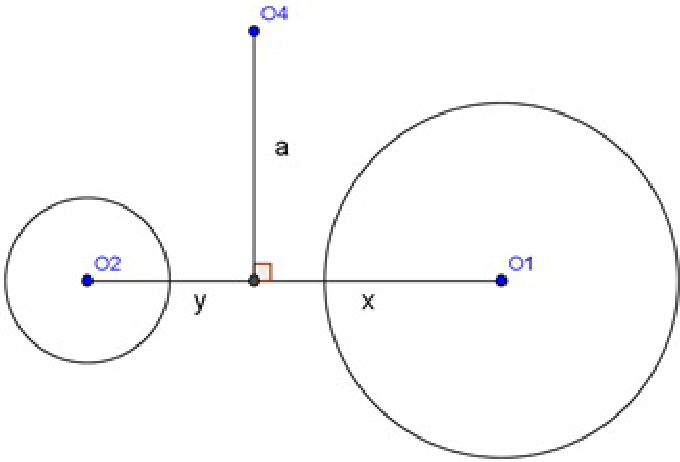
d) The answer is no. Let ωi=C(Oi,Ri) and dij=∣Oi−Oj∣. We assume that R1≥R2≥R3≥R4. According to the problems assumption we must have dij2−(Ri−Rj)2=1. Note that these equations are invariant under addition of a constant number to Ri's (1≤i≤n). Therefore, we can suppose that R4=0 and O4 lies on the radical axis of ω1 and ω2. According to the following figure we have: a2+x2−R12a2+y2−R22(x+y)2−(R1−R2)2=1,=1,=1.
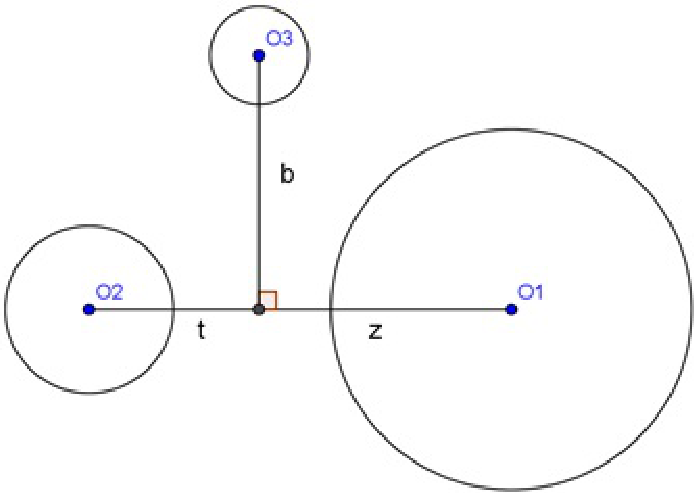
Subtracting the sum of the first two equations from the third one implies: 2xy+2R1R2+2−2a2=1⇒a=21+xy+R1R2. On the other hand, by subtraction of the first equation from the second one we have: {x2−y2=R12−R22x+y=d12⇒x−y⇒{x,y}=2d12±2d12R12−R22⇒xy=4d122−(d12R12−R22)2.=d12R12−R22 Hence a=21+4d122−4d122(R12−R22)2+R1R2. Now, replacing R1, R2 and R3 by R1−R3, R2−R3 and 0 yields: b=21+4d122−4d122((R1−R3)2−(R2−R3)2)2+(R1−R3)(R2−R3).
There are two possibilities. Case 1.O3 and O4 are not on the same side of O1O2. In this case we have O3O42−R32=1⇒1+R32=O3O42≥(a+b)2≥a2+b2. On the other hand, a2>21+R1R2, b2>21+(R1−R3)(R2−R3), so R32>R1R2+(R1−R3)(R2−R3)⇒(R1+R2)R3>2R1R2. But this is in contradiction with the assumption that R1≥R2≥R3.
Case 2.O3 and O4 are on the same side of O1O2. In this case we have 1+R32⇒0⇒4ab+4xz=(a−b)2+(x−z)2=(a2+x2)+(b2+z2)−2ab−2xz=1+R12+1+(R1−R3)2−2ab−2xz=1+2R12−2R1R3−2ab−2xz=2+4R1(R1−R3). Substituting d122=1+(R1−R2)2 implies a=21+4d122−4d122(R12−R22)2+R1R2=43+4(R1+R2)2−4(1+(R1−R2)2)(R1−R2)2(R1+R2)2 Similarly, b=43+4(R1+R2−2R3)2−4(1+(R1−R2)2)(R1−R2)2(R1+R2−2R3)2 Defining tsr:=R1−R2,:=R1+R2−2R3,:=R1+R2, we have ab=43+4r2−4(1+t2)r2t2=43+4(1+t2)r2,=43+4(1+t2)s2. Also, xz=(2d12+2d12R12−R22)(2d12+2d12(R1−R3)2−(R2−R3)2)=41+t2+4rt+4st+4(1+t2)rst2. Now, we have: 4ab+4xz⇒(3+1+t2r2)(3+1+t2s2)+1+t2+rt+st+1+t2rst2=2+4R1(R1−R3)=2+(r+t)(s+t). Multiplication by 1+t2 and some computations yields: (3+3t2+r2)(3+3t2+s2)=1+t2+rs, which is in contradiction with the Cauchy-Schwarz inequality.
Want a route through all this instead of an archive? The track
puts 2,604 problems in a working order, from Junior Challenge level to the IMO shortlist.
Source: MathNet,
licensed CC-BY-4.0.
Statement reproduced verbatim; metadata (topic, difficulty) added by this project.