Maths Olympiad Prep

Library / IMO Shortlist /165 of 365

IMO Shortlist, 2019

Geometry Difficulty 8.5 Shortlist Prove it IMO

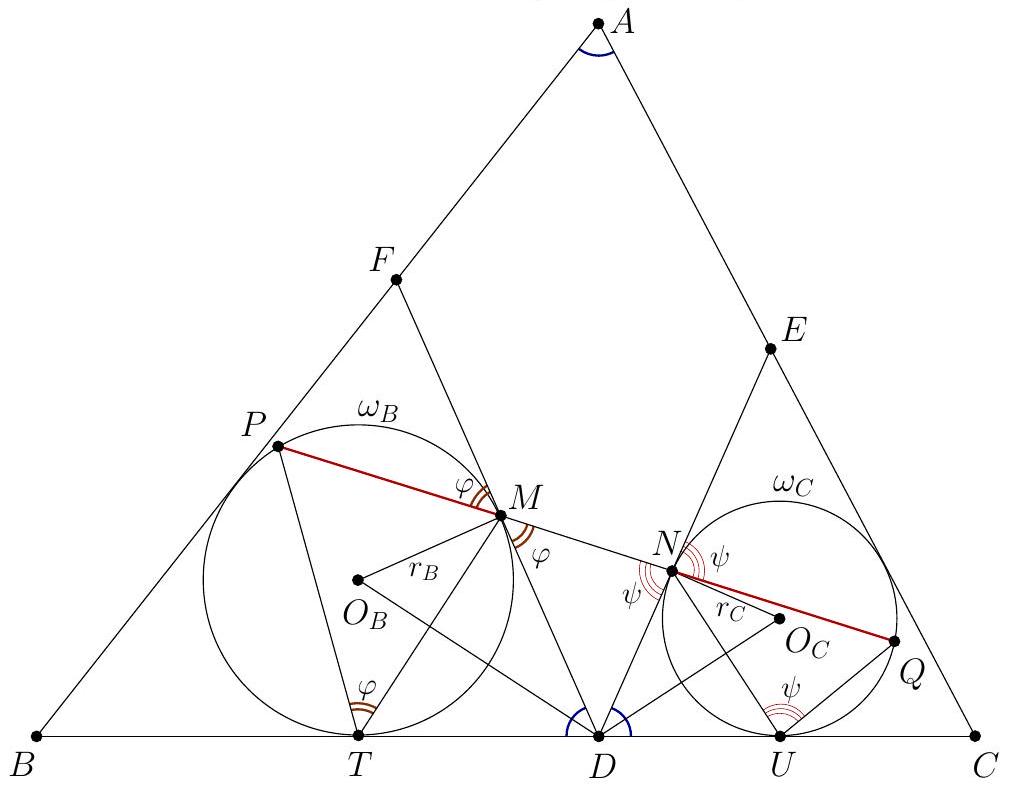
Let ABCABC be an acute-angled triangle and let DD, EE, and FF be the feet of altitudes from AA, BB, and CC to sides BCBC, CACA, and ABAB, respectively. Denote by ωB\omega_{B} and ωC\omega_{C} the incircles of triangles BDFBDF and CDECDE, and let these circles be tangent to segments DFDF and DEDE at MM and NN, respectively. Let line MNMN meet circles ωB\omega_{B} and ωC\omega_{C} again at P≠MP \neq M and Q≠NQ \neq N, respectively. Prove that MP=NQMP = NQ.
(Vietnam)

Solution

Denote the centres of ωB\omega_{B} and ωC\omega_{C} by OBO_{B} and OCO_{C}, let their radii be rBr_{B} and rCr_{C}, and let BCBC be tangent to the two circles at TT and UU, respectively.

Figure 1

From the cyclic quadrilaterals AFDCAFDC and ABDEABDE we have
∠MDOB=12∠FDB=12∠BAC=12∠CDE=∠OCDN, \angle MDO_{B} = \frac{1}{2} \angle FDB = \frac{1}{2} \angle BAC = \frac{1}{2} \angle CDE = \angle O_{C}DN,
so the right-angled triangles DMOBDMO_{B} and DNOCDNO_{C} are similar. The ratio of similarity between the two triangles is
DNDM=OCNOBM=rCrB. \frac{DN}{DM} = \frac{O_{C}N}{O_{B}M} = \frac{r_{C}}{r_{B}}.
Let φ=∠DMN\varphi = \angle DMN and ψ=∠MND\psi = \angle MND. The lines FMFM and ENEN are tangent to ωB\omega_{B} and ωC\omega_{C}, respectively, so
∠MTP=∠FMP=∠DMN=φand∠QUN=∠QNE=∠MND=ψ. \angle MTP = \angle FMP = \angle DMN = \varphi \quad \text{and} \quad \angle QUN = \angle QNE = \angle MND = \psi.
(It is possible that PP or QQ coincides with TT or UU, or lie inside triangles DMTDMT or DUNDUN, respectively. To reduce case-sensitivity, we may use directed angles or simply ignore angles MTPMTP and QUNQUN.)

In the circles ωB\omega_{B} and ωC\omega_{C} the lengths of chords MPMP and NQNQ are
MP=2rB⋅sin⁡∠MTP=2rB⋅sin⁡φandNQ=2rC⋅sin⁡∠QUN=2rC⋅sin⁡ψ. MP = 2r_{B} \cdot \sin \angle MTP = 2r_{B} \cdot \sin \varphi \quad \text{and} \quad NQ = 2r_{C} \cdot \sin \angle QUN = 2r_{C} \cdot \sin \psi.
By applying the sine rule to triangle DNMDNM we get
DNDM=sin⁡∠DMNsin⁡∠MND=sin⁡φsin⁡ψ. \frac{DN}{DM} = \frac{\sin \angle DMN}{\sin \angle MND} = \frac{\sin \varphi}{\sin \psi}.
Finally, putting the above observations together, we get
MPNQ=2rBsin⁡φ2rCsin⁡ψ=rBrC⋅sin⁡φsin⁡ψ=DMDN⋅sin⁡φsin⁡ψ=sin⁡ψsin⁡φ⋅sin⁡φsin⁡ψ=1, \frac{MP}{NQ} = \frac{2r_{B} \sin \varphi}{2r_{C} \sin \psi} = \frac{r_{B}}{r_{C}} \cdot \frac{\sin \varphi}{\sin \psi} = \frac{DM}{DN} \cdot \frac{\sin \varphi}{\sin \psi} = \frac{\sin \psi}{\sin \varphi} \cdot \frac{\sin \varphi}{\sin \psi} = 1,
so MP=NQMP = NQ as required.

Want a route through all this instead of an archive? The track puts 2,604 problems in a working order, from Junior Challenge level to the IMO shortlist.

Source: MathNet, licensed CC-BY-4.0. Statement reproduced verbatim; metadata (topic, difficulty) added by this project.