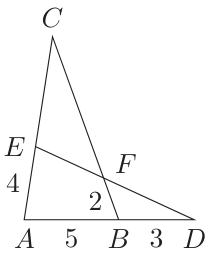
a.
Because angles ∠AEC and ∠ABD are straight, we have
∠ABC=180∘−∠DBC=180∘−∠DEC=∠AED.
Because angle A occurs in both triangles, triangles △ABC and △AED have two equal angles, and hence the triangles are similar. ☐
b.
Because of the similarity of triangles △ABC and △AED, the angles at C and D are equal. Together with the equality ∠DBF=∠CEF, it follows that triangles △DBF and △CEF are similar.
In a pair of similar triangles, all pairs of sides have the same ratio. Hence, the similarity of triangles △DBF and △CEF yields
∣EF∣∣BF∣=∣FC∣∣FD∣=∣CE∣∣DB∣(1)
As triangles △ABC and △AED are similar, we find that
∣AE∣∣AB∣=∣ED∣∣BC∣=∣DA∣∣CA∣(2)
Using equations (1) and (2), we can now find ∣CF∣. Using the first and last ratio in equation (2), we get 45=∣AE∣∣AB∣=∣AD∣∣AC∣=5+34+∣EC∣. Hence, we have ∣EC∣=6. If we substitute this in the first and third ratio in equation (1), we get ∣EF∣2=63. Hence, we have ∣EF∣=4. Using the first and second ratio in (1), we now get that 42=∣FC∣∣FD∣ hence ∣FD∣=21∣CF∣. Finally, we substitute this in the first and second ratio in equation (2):
45=∣AE∣∣AB∣=∣DE∣∣BC∣=4+21∣CF∣2+∣CF∣.
Taking cross ratios and solving the remaining equation, we get ∣CF∣=8. ☐