Points and divide side of equilateral triangle into three equal parts; is between and . Point on side is such that . Find the sum of the angles
Argentine National Olympiad, 2015
Solution
The conditions give (), also , hence triangle is equilateral. Then
Hence .
On the other hand by the symmetry of the figure (or because triangles and are congruent). Then . So
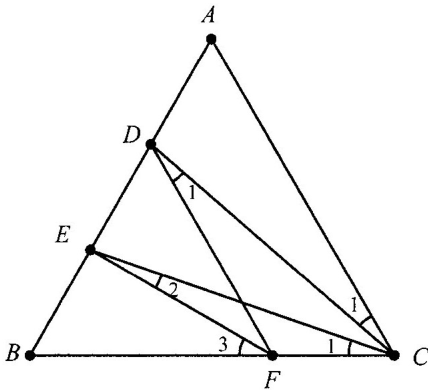
the required sum is equal to . By the exterior angle theorem that last sum equals . Now is a median in the equilateral triangle , hence also a bisector. Therefore , which is the answer to the problem.
Want a route through all this instead of an archive? The track
puts 2,604 problems in a working order, from Junior Challenge level to the IMO shortlist.