Maths Olympiad Prep

Library / Mathematical Olympiad in Ukraine, Fourth Round (March 23, ) /6 of 8

Mathematical Olympiad in Ukraine, Fourth Round (March 23, ), 2010

Geometry Difficulty 6.3 National Olympiad Prove it Ukraine

Point PP lies inside triangle ABCABC. Let IAI_A, IBI_B, ICI_C be incenters of triangles PBCPBC, PACPAC, PABPAB respectively. Let IPI_P denote the incenter of triangle IAIBICI_A I_B I_C. Prove that for point PP which satisfies the condition IP=PI_P = P, the following equalities hold:
AP−BP=AC−BC,BP−CP=BA−CA,CP−AP=CB−AB. AP - BP = AC - BC, \quad BP - CP = BA - CA, \quad CP - AP = CB - AB.

Solution

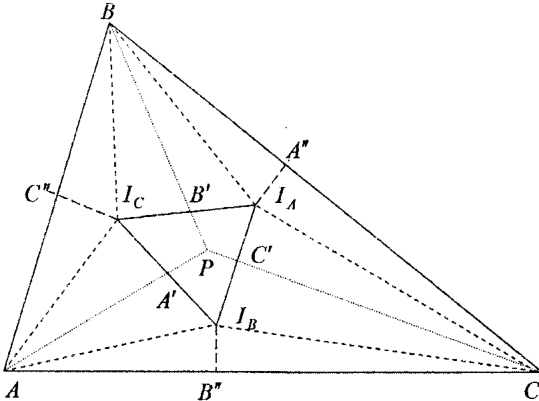
Let us denote the points A′=AP∩IBICA' = AP \cap I_B I_C, B′=BP∩IAICB' = BP \cap I_A I_C, C′=CP∩IBIAC' = CP \cap I_B I_A (see Fig. 11).

IP=PI_P = P implies that IAPI_A P is a bisector of ∠BPC\angle BPC and ∠IBIAIC\angle I_B I_A I_C, therefore two couples of lines IAIBI_A I_B, IAICI_A I_C, and also BPBP, CPCP are symmetric with respect to IAPI_A P. Thus, ∠(IAIB,CP)=∠(BP,IAIC)\angle (I_A I_B, CP) = \angle (BP, I_A I_C) (oriented angles).

By analogy,
∠(IBIC,AP)=∠(CP,IBIA)\angle (I_B I_C, AP) = \angle (CP, I_B I_A),
∠(ICIA,BP)=∠(AP,ICIB)\angle (I_C I_A, BP) = \angle (AP, I_C I_B),
hence,
∠(IAIB,CP)=∠(BP,IAIC)=−∠(AP,ICIB)=∠(CP,IBIA)⇒CP⊥IBIA\angle (I_A I_B, CP) = \angle (BP, I_A I_C) = -\angle (AP, I_C I_B) = \angle (CP, I_B I_A) \Rightarrow CP \perp I_B I_A.

Feet of perpendicular from incenter to the side of triangle coincide with the point where incircle touches this side, hence, incircles of △PAC\triangle PAC and PBCPBC touch CPCP at C′C'. Therefore, they touch each other at C′C'. Analogously, incircles of △PAB\triangle PAB, △PBC\triangle PBC touch PBPB at B′B', and A′A' - incircles of △PAC\triangle PAC, △PAB\triangle PAB.

Let A′′A'' be the point where incircle of △PBC\triangle PBC touches BCBC. We define B′′B'', C′′C'' in the same way. Then

Figure 1
Fig. 11

AP+BC=PA′+AA′+BA′′+A′′C=PB′+AB′′+BB′+B′′C=BP+AC. AP + BC = PA' + AA' + BA'' + A''C = PB' + AB'' + BB' + B''C = BP + AC.

Following the same lines, we get AP+BC=CP+ABAP + BC = CP + AB. Hence, PP is such a point that AP−BP=AC−BCAP - BP = AC - BC, BP−CP=BA−CABP - CP = BA - CA, CP−AP=CB−ABCP - AP = CB - AB, and we are done.

Want a route through all this instead of an archive? The track puts 2,604 problems in a working order, from Junior Challenge level to the IMO shortlist.

Source: MathNet, licensed CC-BY-4.0. Statement reproduced verbatim; metadata (topic, difficulty) added by this project.