Let be a triangle whose incircle () is tangent to , at , respectively. Denote by , the lines symmetric to the lines , with respect to , correspondingly. Suppose that , meet at .
1. Prove that .
2. If , prove that .
Saudi Arabian Mathematical Competitions
Solution
1. Denote by , the intersections of , and respectively. Consider triangle : it is easy to see that
- is the internal bisector of
- is the external bisector of .
Hence, is the excenter of this triangle, which implies that is the bisector of .
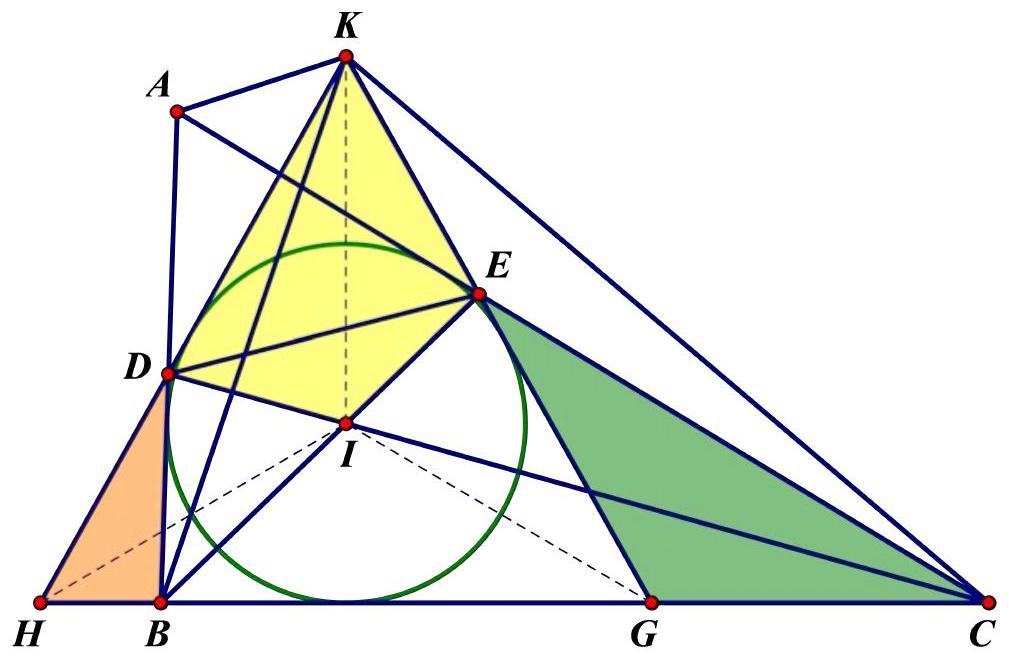
Similarly, we can also see that is the bisector of . So is the incenter of triangle and is the bisector of .
In the other hand, , are symmetric with respect to the line and , are also symmetric with respect to the line . From these facts, we can conclude that .
Similarly, we also have ; therefore, is an isosceles triangle.
Since is the incenter of the isosceles triangle , is also an altitude, i.e. .
2. Denote , , and . Then .
In the isosceles triangle , we have , so . Hence, if , then
and . From the cosine law in triangle , we have
By calculating, it is also easy to check that , ; thus,
which is true.
Want a route through all this instead of an archive? The track
puts 2,604 problems in a working order, from Junior Challenge level to the IMO shortlist.