Given an isosceles triangle ABC with AB=AC. The midpoint of side BC is denoted by M. Let X be a variable point on the shorter arc MA of the circumcircle of triangle ABM. Let T be the point in the angle domain BMA, for which ∠TMX=90∘ and TX=BX. Prove that ∠MTB−∠CTM does not depend on X.
Solutions — 2
Solution 1
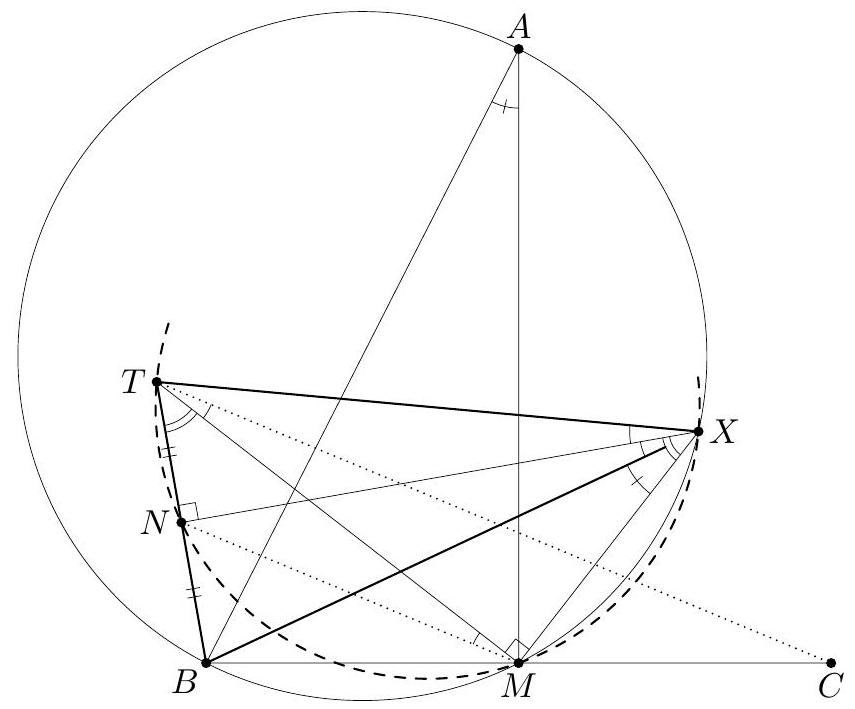
Let N be the midpoint of segment BT (see Figure 1). Line XN is the axis of symmetry in the isosceles triangle BXT, thus ∠TNX=90∘ and ∠BXN=∠NXT. Moreover, in triangle BCT, line MN is the midline parallel to CT; hence ∠CTM=∠NMT. Due to the right angles at points M and N, these points lie on the circle with diameter XT. Therefore, ∠MTB=∠MTN=∠MXNand∠CTM=∠NMT=∠NXT=∠BXN. Hence ∠MTB−∠CTM=∠MXN−∠BXN=∠MXB=∠MAB which does not depend on X.
Figure 1
Solution 2
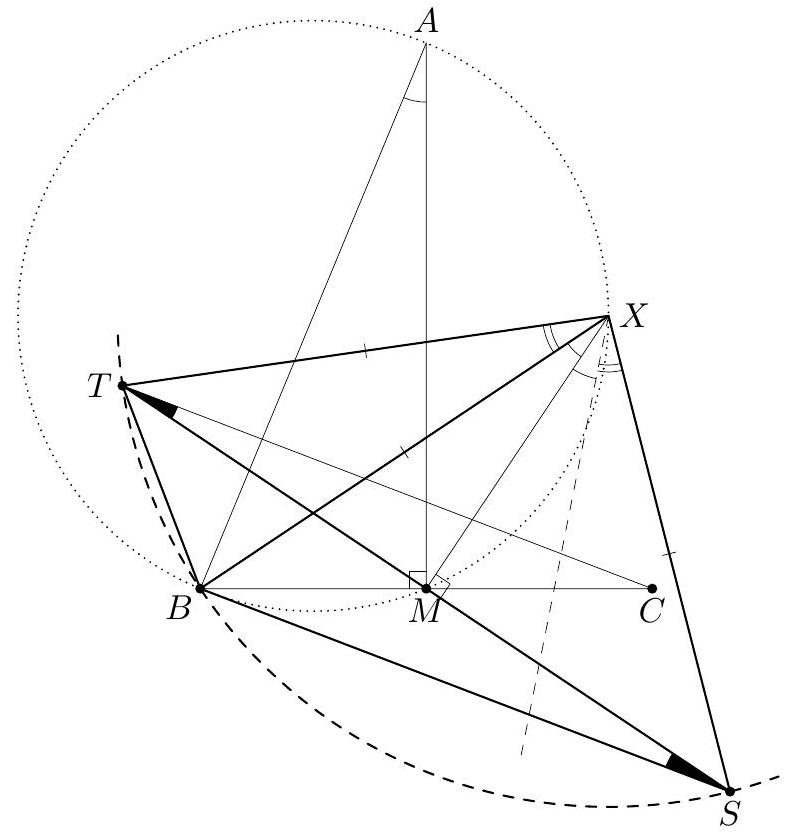
Let S be the reflection of point T over M (see Figure 2). Then XM is the perpendicular bisector of TS, hence XB=XT=XS, and X is the circumcenter of triangle BST. Moreover, ∠BSM=∠CTM since they are symmetrical about M. Then ∠MTB−∠CTM=∠STB−∠BST=2∠SXB−∠BXT. Observe that ∠SXB=∠SXT−∠BXT=2∠MXT−∠BXT, so ∠MTB−∠CTM=22∠MXT−2∠BXT=∠MXB=∠MAB, which is constant.
Figure 2
Want a route through all this instead of an archive? The track
puts 2,604 problems in a working order, from Junior Challenge level to the IMO shortlist.
Source: MathNet,
licensed CC-BY-4.0.
Statement reproduced verbatim; metadata (topic, difficulty) added by this project.