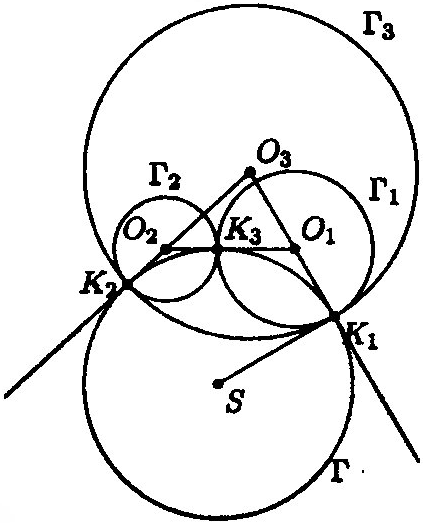
Let O1,O2,O3 be respectively the centers of the circles Γ1,Γ2,Γ3, and R1,R2,R3 be their radii.
Let Γ be the circumscribed circle of the triangle O1O2O3 (see Fig. 1), and let Γ touch the lines O3O1,O3O2,O1O2 at points K1,K2,K3 respectively. Then
O1K1=O1K3,O2K2=O2K3⟹O1K1+O2K2=O1O2=R1+R2.(1)
Moreover
(R3−R1)+O1K1=O3O1+O1K1=O3K1=O3K2=O3O2+O2K2=(R3−R2)+O2K2.
---
Therefore, if O1K1>R1 (O1K1<R1), then O2K2=O3K2−(R3−R2)=(R3−R1)+O1K1−(R3−R2)=R2+(O1K1−R1)>R2, (O2K2<R2), which gives O1K1+O2K2>R1+R2 (O1K1+O2K2<R1+R2), contrary to (1). Therefore, O1K=R1, O2K2=R2. So K1,K2,K3 coincide with M1,M2,M3 respectively. It means that Γ is circumcircle of the triangle M1M2M3 (see Fig. 2). So SM1⊥O3O1 (as the radius of the inscribed circle), thus SM1 is the tangent to Γ3.