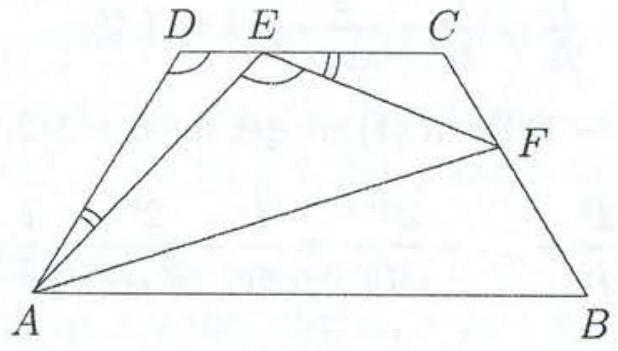
The quadrilateral ABCD has AD=DC=CB<AB and AB∥CD. Points E and F lie on the sides CD and BC such that ADE=AEF. Prove that:
a. 4CF≤CB.
b. If 4CF=CB, then AE is the angle bisector of DAF.
Solution
a. FEC=180∘−AEF−DEA =180∘−ADE−DEA=DAE From AD=DC=CB<AB and AB∥CD it follows that ADC=DCB, hence triangles ADE and ECF are similar. This yields ECAD=EFAE=CFDE.(1) This leads to AD⋅CF=EC⋅DE≤41(EC+DE)2=41CD2, hence 4CF≤CB, because AD=DC=CB.
b. If 4CF=CB, then the inequality EC⋅DE≤41(EC+DE)2 becomes an equality, that is CE=ED.
Relation (1) becomes DEAD=EFAE. Since ADE=AEF, triangles ADE and AEF are similar.
Then DAE=EAF, so AE bisects the angle DAF.
Want a route through all this instead of an archive? The track
puts 2,604 problems in a working order, from Junior Challenge level to the IMO shortlist.
Source: MathNet,
licensed CC-BY-4.0.
Statement reproduced verbatim; metadata (topic, difficulty) added by this project.