Maths Olympiad Prep

Library / /7 of 17

Geometry Difficulty 5.7 AIME, harder Prove it Argentina

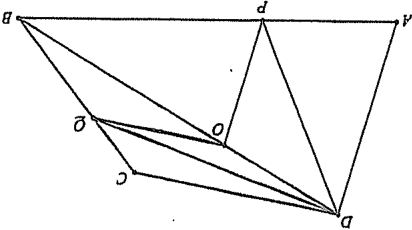
Given is a convex quadrilateral ABCDABCD with AB=BD=aAB = BD = a and CD=DA=bCD = DA = b. Let PP in side ABAB such that DPDP is bisector of ADB\vec{ADB} and QQ in side BCBC such that DQDQ is bisector of CDB\vec{CDB}. Find the circumradius of triangle DPQDPQ.

Solution

Let the parallel to ADAD through PP intersect BDBD at OO. We show that OO is the circumcenter of DPQDPQ.

One has ADP=BDP\vec{ADP} = \vec{BDP} (DPDP bisects ADB\vec{ADB}) and ADP=OPD\vec{ADP} = \vec{OPD} (as POADPO \parallel AD). Hence ODP=OPD\vec{ODP} = \vec{OPD} and so OP=ODOP = OD. Also DO=APDO = AP, BO=BPBO = BP as triangle ADBADB is isosceles, then DOBO=APBP=DADB=ba\frac{DO}{BO} = \frac{AP}{BP} = \frac{DA}{DB} = \frac{b}{a} by the bisector theorem in triangle ABDABD.

On the other hand the same theorem in triangle BCDBCD gives CQBO=DCDB=ba\frac{CQ}{BO} = \frac{DC}{DB} = \frac{b}{a}. In summary,

DOBO=ba=CQBO. \frac{DO}{BO} = \frac{b}{a} = \frac{CQ}{BO}.

Now the converse of Thales' theorem implies QQCDQQ \parallel CD. Then

Figure 1

BDQ^=CDQ^=OQD^B\hat{DQ} = C\hat{DQ} = O\hat{QD}, hence OQ=ODOQ = OD. We obtained OP=OQ=ODOP = OQ = OD, meaning that OO is the circumcenter of DPQDPQ.

In addition OD=APOD = AP from the isosceles triangle ADBADB. Since AP+BP=aAP + BP = a and APBP=ba\frac{AP}{BP} = \frac{b}{a}, standard calculus lead to AP=aba+bAP = \frac{ab}{a+b}, so triangle DPQDPQ has circumradius aba+b\frac{ab}{a+b}.

Want a route through all this instead of an archive? The track puts 2,000 problems in a working order, from AMC 10 level to the IMO shortlist.

Source: MathNet, licensed CC-BY-4.0. Statement and solution reproduced as published; topic and difficulty added by this site.