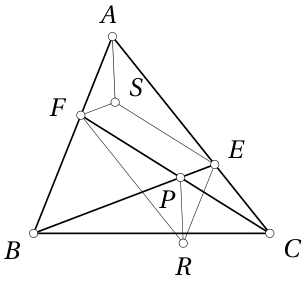
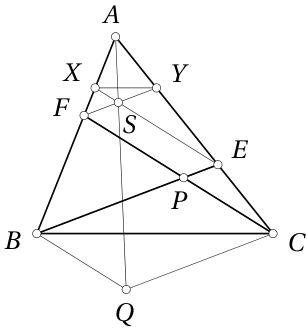
Points E and F are chosen respectively on the sides CA and AB of triangle ABC. Lines BE and CF intersect at P. Let Q be a point such that PBQC is a parallelogram and R a point such that AERF is a parallelogram. Prove that PR∥AQ.
Solutions — 2
Solution 1
Let S be a point such that PESF is a parallelogram (Fig. 15). We first show that PR∥AS. For this note that ∠PER=∠SFA since PE∥FS and ER∥AF. Additionally PE=FS and ER=AF, thus triangles PER and SFA are congruent. From this we deduce that PR∥AS.
In order to prove the problem statement it now suffices to show that A, S and Q are collinear. Let X be the point of intersection of ES and AF and Y be the point of intersection of FS and AE (Fig. 16).
First we show that XY∥BC. Denote ACAE=κ and ABAF=λ. As EX∥CF, we have AFAX=ACAE=κ. Thus ABAX=AFAX⋅ABAF=κ⋅λ. Analogously, we get ACAY=κ⋅λ. Consequently, ABAX=ACAY, which implies XY∥BC.
The fact just proven implies BCXY=ABAX. It suffices to notice that the triangles BCQ and XYS are similar as their respective sides are parallel. Thus XS=XY which implies XS=ABAX. Since XS∥BQ, this implies that the points A, S and Q are collinear.
Fig. 15 Fig. 16
Solution 2
Denote AC=e1 and AB=e2. Take κ,λ such that AE=κe1 and AF=λe2. Then AREBFC=AE+AF=κe1+λe2,=AB−AE=e2−κe1,=AC−AF=e1−λe2. Take also α,β such that EP=αEB and FP=βFC. Then APAP=AF+βFC=λe2+β(e1−λe2)=βe1+(1−β)λe2,=AE+αEB=κe1+α(e2−κe1)=(1−α)κe1+αe2. Consequently, βe1+(1−β)λe2=(1−α)κe1+αe2. As vectors e1 and e2 are not parallel, the equality can hold only if the respective coefficients are equal, i.e., β=(1−α)κ and (1−β)λ=α. This implies AP=βe1+αe2. Now we obtain PRAQ=AR−AP=(κe1+λe2)−(βe1+αe2)=(κ−β)e1+(λ−α)e2,=AC+CQ=AC+PB=AC+AB−AP=e1+e2−(βe1+αe2)=(1−β)e1+(1−α)e2. The lines PR and AQ being parallel is equivalent to the vectors PR and AQ being parallel, which in turn is equivalent to their coefficients being proportional. Hence it suffices to show that 1−βκ−β=1−αλ−α, or equivalently, (κ−β)(1−α)=(λ−α)(1−β). As κ(1−α)=β and λ(1−β)=α, we have (κ−β)(1−α)(λ−α)(1−β)=κ(1−α)−β(1−α)=β−β+αβ=αβ,=λ(1−β)−α(1−β)=α−α+αβ=αβ. Hence the desired equality holds and the proof is complete.
Want a route through all this instead of an archive? The track
puts 2,604 problems in a working order, from Junior Challenge level to the IMO shortlist.
Source: MathNet,
licensed CC-BY-4.0.
Statement reproduced verbatim; metadata (topic, difficulty) added by this project.