Maths Olympiad Prep

Library / /40 of 53

Geometry Difficulty 7.0 National olympiad, round 2 Prove it Vietnam

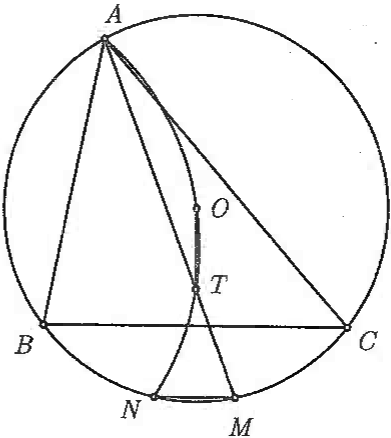
Let ABCABC be an acute, scalene triangle with the circumcircle (OO) and angles ACBACB, ABCABC are acute. Let MM be a point on arc BCBC that does not contain AA and AMAM is not perpendicular to BCBC. The line AMAM meets the perpendicular bisector of BCBC at TT and the circumcircle of triangle AOTAOT meets OO at NN (NAN \neq A).

a) Prove that BAM=CAN\angle BAM = \angle CAN.

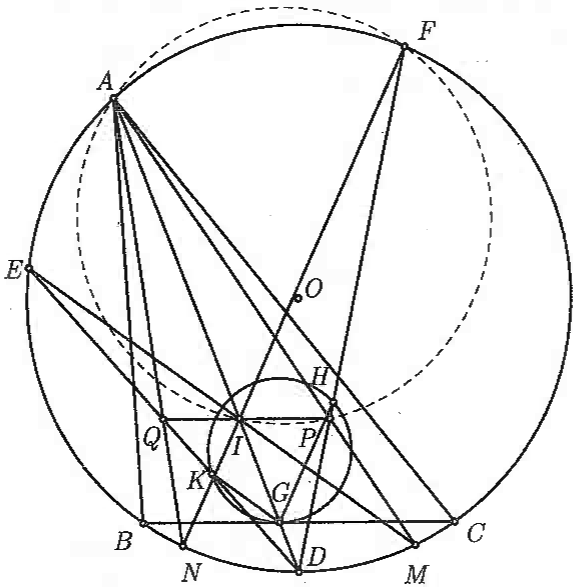
b) Let II be the incenter of triangle ABCABC and GG be the foot of the internal angle bisector of BAC\angle BAC. Let AIAI, MIMI and NINI intersect (OO) at DD, EE and FF respectively. Let PP, QQ be the intersections of DFDF and AMAM, DEDE and ANAN. The circle passing through PP and touches ADAD at II meets DFDF at HH (HDH \neq D). Similarly, the circle passing through QQ and touches ADAD at II meets DEDE at KK (KDK \neq D). Prove that the circumcircle of triangle GHKGHK touches BCBC.

Solution

Figure 1

a) Since AOTNAOTN is a cyclic quadrilateral, TNO=TAO=TMO\angle TNO = \angle TAO = \angle TMO, hence
TMN=OMNOMT=ONMONT=TNM \angle TMN = \angle OMN - \angle OMT = \angle ONM - \angle ONT = \angle TNM
which means TM=TNTM = TN or OTOT is a perpendicular bisector of MNMN. On the other hand, OTOT is a perpendicular bisector of BCBC

hence BCMNBCMN is a regular trapezoid thus BM=CNBM = CN. This means BAM=CAN\angle BAM = \angle CAN as desired.

b) Clearly, ADAD is the bisector of BAC\angle BAC, hence BAD=CAD\angle BAD = \angle CAD or NAD=MAD\angle NAD = \angle MAD. By angle chasing, we have
PFI=DAN=MAD=PAI \angle PFI = \angle DAN = \angle MAD = \angle PAI
which implies AA, PP, FF and II are concyclic. Similarly, QQ, II, AA and EE are concyclic. By Reim's theorem, we obtain that PIMNPI \parallel MN and QIMNQI \parallel MN hence II, PP and QQ are collinear and PQBCPQ \parallel BC.
Figure 2

On the other hand, DKDQ=DI2=DPDH\overline{DK} \cdot \overline{DQ} = DI^2 = \overline{DP} \cdot \overline{DH} so PP, QQ, KK and HH are concyclic. Moreover, since DGBDBA\angle DGB \sim \angle DBA, we obtain
DPDH=DI2=DB2=DGDA \overline{DP} \cdot \overline{DH} = DI^2 = DB^2 = \overline{DG} \cdot \overline{DA}
and AA, FF, PP and II are concyclic, it implies DPDF=DIDA\overline{DP} \cdot \overline{DF} = \overline{DI} \cdot \overline{DA}. Therefore,
DFDH=DIDG \frac{\overline{DF}}{\overline{DH}} = \frac{\overline{DI}}{\overline{DG}}
which means GHIFGH \parallel IF. Similarly, GKIEGK \parallel IE hence by Thales's theorem, HKFEHK \parallel FE. By angle chasing, one can get
HKG=FEI=FNM=FAP=FIP=PGC \angle HKG = \angle FEI = \angle FNM = \angle FAP = \angle FIP = \angle PGC
then the circumcircle of triangle GHKGHK touches BCBC at GG. \square

Want a route through all this instead of an archive? The track puts 2,000 problems in a working order, from AMC 10 level to the IMO shortlist.

Source: MathNet, licensed CC-BY-4.0. Statement and solution reproduced as published; topic and difficulty added by this site.