If z1,z2,…,zn are vertices of P then ∣z1∣=∣z2∣=⋯=∣zn∣=1. By the rotation we can assume that ∏i=1nzi=1. We know that
∣w−z1∣⋅∣w−z2∣⋯∣w−zn∣=∣(w−z1)⋯(w−zn)∣.
Let P(w)=∏i=1n(w−zi) and P(w)=wn+Q(w)+1, here Q(w)=an−1wn−1+⋯+a1w.
Consider the nth roots of unity ϵ0,ϵ1,…,ϵn−1. Therefore ∑s=0n−1ϵs=0.
Here s≡0(modn) we get
i=1∑n−1Q(ϵi)=j=1∑n−1(aj⋅i=0∑n−1ϵj)=0
a) Assume to the contrary. If there exist i such that Q(ϵi)=ai+bi, ai>0 then
P(ϵi)=ϵin+1+Q(ϵi)=2+ai+bi⋅i,
thus we have ∣P(ϵi)∣>2. Hence Q(ϵi)=bi⋅i for arbitrary i. Because we have ∑i=0n−1ai=0 and all of ai is less than or equal to zero, thus ai=0 for arbitrary i. Now suppose that for arbitrary i: bi=0 then
P(ϵi)=ϵin+1+Q(ϵi)=2+bi⋅i.
So ∣P(ϵi)∣>2. This leads contradiction.
Now for arbitrary i, we have Q(ϵi)=0, i=0,n−1. But degQ(w)=n−1, hence Q(w) is zero polynomial.
Thus P(w)=wn+1, we get ∣P(ϵi)∣=∣ϵin+1∣=2
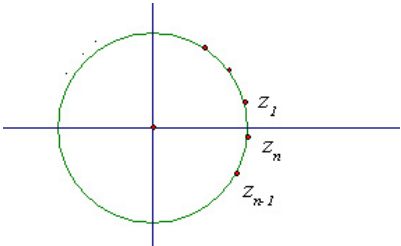
b) From part a), the multiplication greater than or equal to 2, it must be P(w)=wn+1, wn+1=0 equation's solutions are
zi=cos2n2π(2k+1)+isin2n2π(2k+1),k=0,n−1