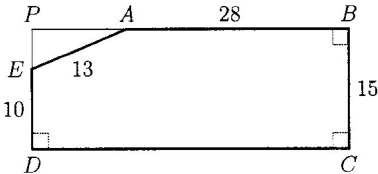
The pentagon ABCDE, with sides AB, BC, CD, DE and EA, satisfies the following conditions: ∙∠ABC=∠BCD=∠CDE=90∘ ∙CD is longer than AB. ∙AB=28, BC=15, DE=10 and EA=13. Calculate the area of the pentagon.
Solution
Extend BA and DE so that they meet at point P. AB=28, BC=15, DE=10 and EA=13. The quadrilateral PBCD has three right angles, so the fourth is also a right angle, hence it is a rectangle. Then PD=BC=15, therefore PE=PD−DE=15−10=5. Now we apply Pythagoras' theorem in the right-angled triangle APE to determine the length of AP: AP=AE2−PE2=132−52=144=12. We conclude that PB=PA+AB=12+28=40. To calculate the area of the pentagon ABCDE, we subtract the area of the triangle APE from the area of the rectangle PBCD, that is: area(ABCDE) = 40 ⋅ 15 - 12 5}{2} = 600 - 30 = 570.
Want a route through all this instead of an archive? The track
puts 2,604 problems in a working order, from Junior Challenge level to the IMO shortlist.
Source: MathNet,
licensed CC-BY-4.0.
Statement reproduced verbatim; metadata (topic, difficulty) added by this project.