Olympiad Maths Prep

Library / /3 of 6

Geometry Difficulty 6.2 National olympiad Prove it Turkey

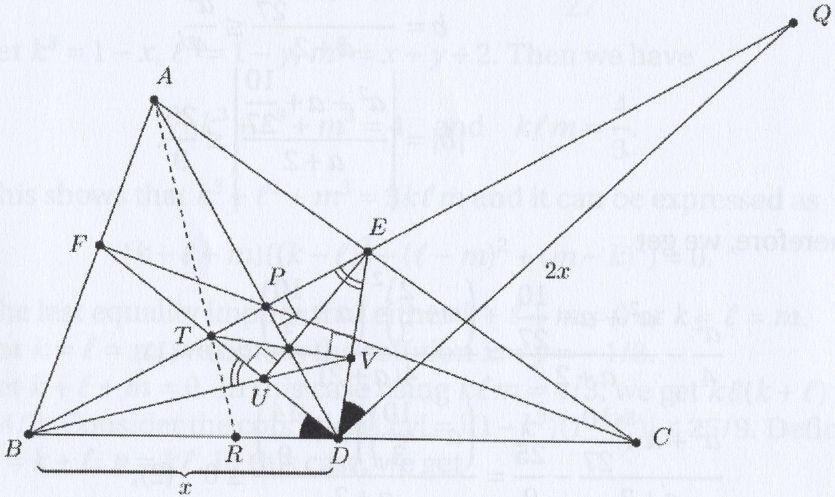
Let PP be a point inside the triangle ABCABC. The lines APAP, BPBP and CPCP intersect the sides BCBC, CACA and ABAB at points DD, EE and FF, respectively. Let QQ be a point on the ray [BE[BE such that E[BQ]E \in [BQ] and EDQ=FDB\angle EDQ = \angle FDB. Suppose that BEADBE \perp AD and DQ=2BD|DQ| = 2|BD|. Prove that FDE=60\angle FDE = 60^\circ.

Solutions — 2

Solution 1

Let FDBP=TFD \cap BP = T and ATBC=RAT \cap BC = R. Using Menelaus and Ceva theorems, we get
BCDC=BFAFAPPD=BRDR. \frac{BC}{DC} = \frac{BF}{AF} \cdot \frac{AP}{PD} = \frac{BR}{DR}.
Figure 1
This shows that the points BB, RR, DD, CC are harmonic. The lines ABAB, ARAR, ADAD, ACAC form a harmonic pencil and hence it follows that the points BB, TT, PP, EE are also harmonic. In triangle DTEDTE, let UU and VV be the feet of the perpendicular lines from the vertices EE and TT to the opposite sides. Since [DP][DP] is an altitude, the lines EUEU, TVTV, DPDP are concurrent. As the points BB, TT, PP, EE are harmonic, using Ceva theorem, we get
EVVDDUUT=EPTP=EBTB. \frac{EV}{VD} \cdot \frac{DU}{UT} = \frac{EP}{TP} = \frac{EB}{TB}.

Therefore, the points BB, UU, VV satisfy the Menelaus theorem in the triangle TDETDE which in turn implies that the points BB, UU, VV are collinear. Since the points TT, UU, VV, EE are concyclic, we obtain that TUB=TED\angle TUB = \angle TED and hence BUDQED\triangle BUD \sim \triangle QED. As the similarity ratio is BD/QD=1/2BD/QD = 1/2, we conclude that UD/ED=1/2UD/ED = 1/2. Since EUUDEU \perp UD we get UDE=FDE=60\angle UDE = \angle FDE = 60^\circ and we are done.

Solution 2

As in Solution 1 it can be shown that the points BB, TT, PP, EE are harmonic. Let FDB=QDE=α\angle FDB = \angle QDE = \alpha, PDT=β\angle PDT = \beta, EDP=θ\angle EDP = \theta. We have
sinαsin(α+β+θ)TDDE=BTBE=PTPE=sinβsinθTDDE. \frac{\sin \alpha}{\sin(\alpha + \beta + \theta)} \cdot \frac{TD}{DE} = \frac{BT}{BE} = \frac{PT}{PE} = \frac{\sin \beta}{\sin \theta} \cdot \frac{TD}{DE}.
It follows that
sinαsin(α+β+θ)=sinβsinθ. \frac{\sin \alpha}{\sin(\alpha + \beta + \theta)} = \frac{\sin \beta}{\sin \theta}.
By applying trigonometric transformation formulas we get
sinαsinθ=12(cos(αθ)cos(α+θ))sin(α+β+θ)sinβ=12(cos(α+θ)cos(α+2β+θ)). \sin \alpha \cdot \sin \theta = \frac{1}{2}(\cos(\alpha - \theta) - \cos(\alpha + \theta)) \\ \sin(\alpha + \beta + \theta) \cdot \sin \beta = \frac{1}{2}(\cos(\alpha + \theta) - \cos(\alpha + 2\beta + \theta)).
Therefore, we have
cos(α+θ)=12(cos(αθ)+cos(α+2β+θ))=cos(α+β)cos(β+θ). \cos(\alpha + \theta) = \frac{1}{2}(\cos(\alpha - \theta) + \cos(\alpha + 2\beta + \theta)) = \cos(\alpha + \beta) \cdot \cos(\beta + \theta).
Since 0<α+β<900^\circ < \alpha + \beta < 90^\circ, 0<α+θ<900^\circ < \alpha + \theta < 90^\circ and DPBQDP \perp BQ, we get
cos(α+β)cos(α+θ)=DQBD=2. \frac{\cos(\alpha + \beta)}{\cos(\alpha + \theta)} = \frac{DQ}{BD} = 2.
Finally we obtain that cos(β+θ)=1/2\cos(\beta + \theta) = 1/2 and FDE=β+θ=60\angle FDE = \beta + \theta = 60^\circ and hence we are done.

Looking for a route rather than an archive? The track puts 2,000 problems in a working order, from AMC 10 level to the IMO shortlist.

Source: MathNet, licensed CC-BY-4.0. Statement and solution reproduced as published; topic and difficulty added by this site.