The point is the circumcentre of triangle . The point is on the extension of the side such that is between and , the point is on the extension of the side such that is between and , and the lines and intersect on the circumcircle of triangle . The midpoint of is , and is a point on the circumcircle of triangle such that . Prove that the angle is a right angle.
IRL ABooklet
Solution
Let be the intersection point of and . The circumcircle of triangle has centre and radius . Let be the second intersection point of the circumcircle of triangle and the line . We then have and
Because is cyclic, we have and so which implies that is cyclic. This gives
Adding (12) and (13) gives
Considering the power of the points and with respect to the circle , we obtain
Adding these together yields
To prove that is right angled, we now need a formula for the median of triangle . Such a formula is well known and can be obtained from the Cosine Rule as follows. Let , then and . The Cosine Rule for triangles and gives
Adding these together and taking into account that , we obtain
Because , (14), (15) and (16) give us
and we obtain . Using and , this can be rewritten as
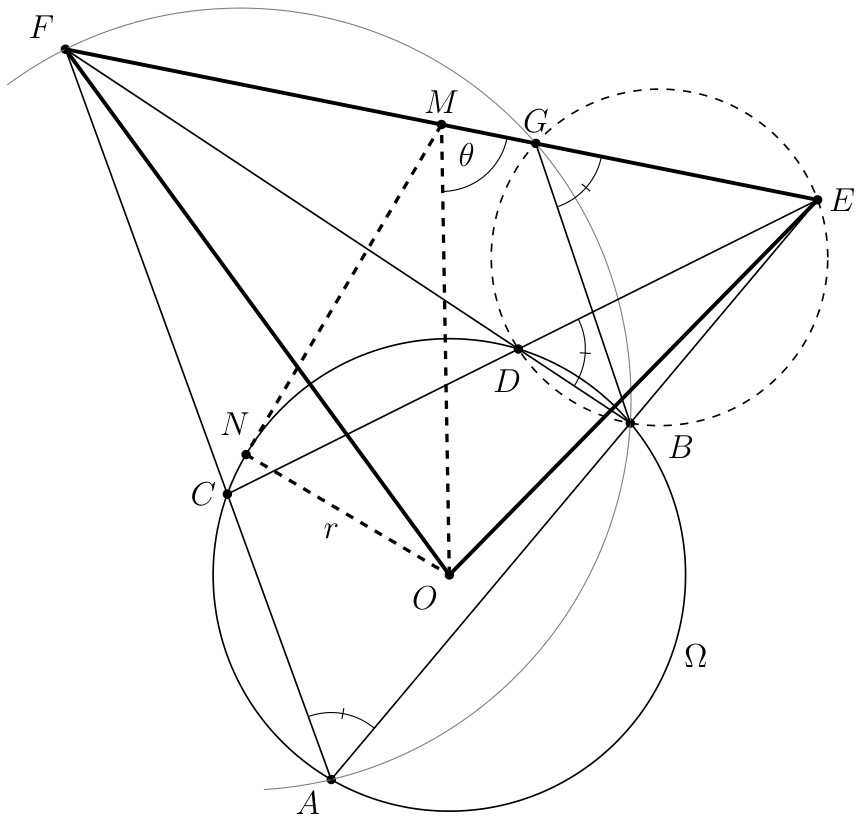
and this means that triangle has a right angle at .
Want a route through all this instead of an archive? The track
puts 2,604 problems in a working order, from Junior Challenge level to the IMO shortlist.