We call a point sequence (A0,A1,…,An) interesting, if the abscissa and ordinate are equal for each Ai, and the slopes of segment OA0,OA1,…,OAn strictly increase (O is the origin), and the area of each △OAiAi+1 (0≤i≤n−1) is 21.
For a point sequence (A0,A1,…,An), insert a point A adjacent to two points Ai,Ai+1 satisfying OA=OAi+OAi+1, then we call thus obtained new point sequence (A0,…,Ai,A,Ai+1,…,An) an expansion of (A0,A1,…,An).
Let (A0,A1,…,An) and (B0,B1,…,Bm) be any two interesting point sequences. Prove that if A0=B0 and An=Bm, then we can expand both point sequences to some same point sequence (C0,C1,…,Ck).
(posed by Qu Zhenhua)
Solution
We see that by the condition of the problem, an expansion of an interesting sequence is still interesting.
First, we construct the interesting sequence (C0,C1,…,Ck) containing all points of sequences (A0,A1,…,An) and (B0,B1,…,Bm), and C0=A0=B0, Ck=An=Bm.
By the Pick Theorem, we know that the area of triangle equals 1/2 if and only if there is no grid point on the triangle except triangle vertices. Hence there is no grid point on △OAiAi+1 except its vertices. Therefore, if the slopes of OAi and OBj are equal, then Ai=Bj.
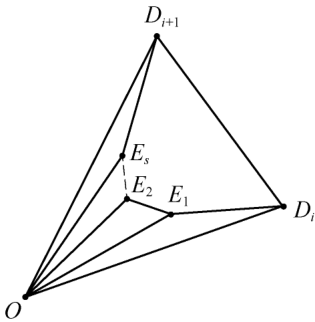
Denote the slopes of segments from points of {Ai} and {Bj} to the origin in strictly increasing order by D0,D1,…,Dl, where D0=C0=A0=B0 and Dl=Ck=An=Bm. If a sequence (Di,Di+1) is not interesting, then we can insert several points E1,…,Es such that the sequence (Di,E1,…,Es,Di+1) is interesting. In fact, consider the convex hull P of the grid points on △ODiDi+1, except the origin. P is a convex polygon or segment DiDi+1 (a degenerated polygon). Then the sequence of vertices of P is interesting. Thus, we have constructed the interesting sequence (C0,C1,…,Ck).
Finally, it suffices to show that the interesting sequence (A0,A1,…,An) can be expanded to (C0,C1,…,Ck), and the same is true for (B0,B1,…,Bm). We only need to prove this for the case of n=1, since we can apply the conclusion for n=1 to (Ai,Ai+1), i=0,1,…,n−1 successively. Let C0=A0 and Ck=A1. By induction on k, for k=1, we need no expansion. Suppose that the conclusion is true for all positive integers less than k.
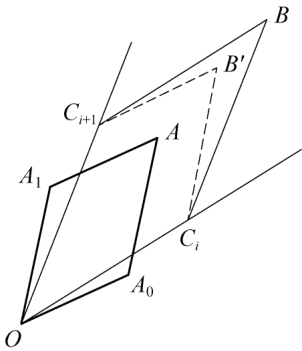
Then denote the grid point A satisfying OA=OA0+OA1, and we see that A must be a point of C1,…,Ck−1. Since if not, there is no grid point on interior of segment OA, and there exists i,0≤i<k, such that A locates in the angle made by rays OCi and OCi+1. We may suppose that i>0, otherwise take the graph symmetric over the line x=y. Since the area of the parallelogram □OA0AA1 is 1, Ci locates outside of □OA0AA1, Ci+1 locates outside of □OA0AA1 or Ci+1=A1. In any way, we take B such that OB=OCi+OCi+1 and take B′ such that Ci+1B′∥OA0, CiB′∥A0A, then A locates on □OCi+1B′Ci. Thus, A locates inside of □OCiBCi+1, which contradicts the fact that the area of □OCiBCi+1 is 1. Therefore the inserted point A to (A0,A1) for expansion is some Ci. Then we use the induction hypotheses to (A0,A) and (A,A1), respectively. □
Want a route through all this instead of an archive? The track
puts 2,604 problems in a working order, from Junior Challenge level to the IMO shortlist.
Source: MathNet,
licensed CC-BY-4.0.
Statement reproduced verbatim; metadata (topic, difficulty) added by this project.