First Solution: Let ∣EB∣=x and ∣AE∣=y, then ∣DC∣=x+y,
∣BC∣=x32,∣AF∣=y24,and so ∣FD∣=x32−y24.
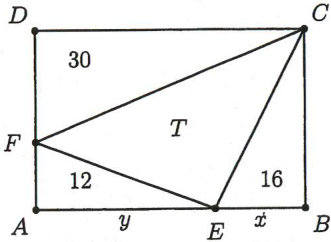
30=21(x32−y24)(x+y)=4+16xy−12yx.
Multiply across by xy and rearrange to get the equation
16(xy)2−26(xy)−12=0
which has only one positive solution xy=2. If T denotes the area of triangle EFC, the area of ABCD is
16+12+30+T=x32(x+y)=32(1+xy)=96
and so T=96−58=38.
Second Solution: (after Adam Kielthy) Let
a=∣AE∣,b=∣EB∣,c=∣AF∣,d=∣FD∣
and denote the triangle areas as follows
YW=∣EBC∣=2b(c+d)=∣AEF∣=2acZX=∣CDF∣=2d(a+b)=∣ECF∣
from which we obtain ac=2W, ad=2Z−bd, bc=2Y−bd.
The area of the rectangle is equal to
X+Y+Z+W=(a+b)(c+d)=ac+ad+bc+bd=2(Y+Z+W)−bd,
which implies bd=Y+Z+W−X. On the other hand, from YZ=bd(a+b)(c+d)/4, we obtain bd=4YZ/(Y+Z+W+X). Therefore, Y+Z+W−X=4YZ/(Y+Z+W+X), i.e. (Y+Z+W)2−X2=4YZ. This implies X2=(Y+Z+W)2−4YZ=(16+30+12)2−4⋅16⋅30=1444, hence X=38.