(a) Because OP is the perpendicular bisector of BC, △PBC is isosceles with symmetry axis PO. Thus ∣PB∣=∣PC∣ and ∠PBC=∠PCB=∠C. Hence ∠APB=2∠C (external angle).
Similarly, OQ is the perpendicular bisector of AC hence △QAC is isosceles with symmetry axis QO. Thus ∣QA∣=∣QC∣ and ∠QAC=∠QCA=∠C. Hence ∠AQB=2∠C (external angle).
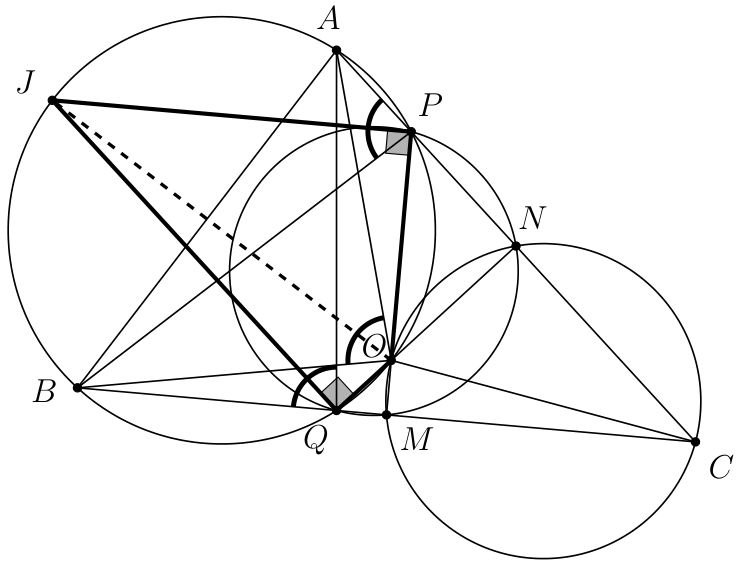
This implies that quadrilateral APQB is cyclic with ∠APB=∠AQB. Because ∠AOB=2∠C by the Central Angle Theorem, the point O lies on this circle as well, i.e. A,P,O,Q,B are all on the same circle.
To show that J is on this circle too, we consider the parallelogram CPJQ.
Because JP∥BC and PO⊥BC, we have ∠OPJ=90∘. Similarly, using JQ∥AC and QO⊥AC we obtain ∠OQJ=90∘. This implies that the four points P,O,Q,J are on the circle with diameter OJ. Hence, A,B,O,P,Q,J are all on the same circle.
(b) The quadrilateral CNOM is cyclic because ∠CNO=90∘ and ∠CMO=90∘, and OC is a diameter of its circumcircle. The quadrilateral MNPQ is cyclic as well since ∠PNQ=∠PMQ=90∘. The line MN is the radical axis of the circumcircles of CNOM and MNPQ.
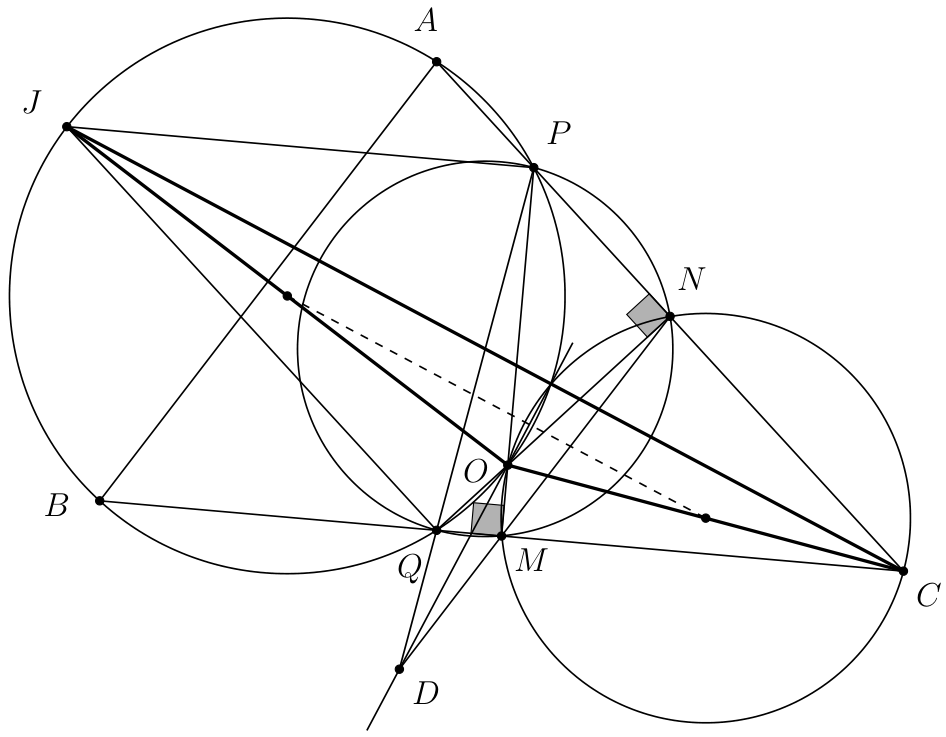
On the other hand, PQ is the radical axis of the circumcircles of APOQB and MNPQ. Hence the point D is the radical centre of the three circles mentioned above. As the circumcircles of ABPOQ and CMON have the point O in common, it follows that OD is the radical axis of these two circles and so is perpendicular to the line that connects the centres of them. These circles have diameters OJ and OC, hence the centre line connects the midpoints of OJ and OC and therefore is parallel to CJ. Hence OD⊥CJ.
Alternative proof of (b).
Using the short notation ∠BAC=∠A, ∠ABC=∠B, ∠BCA=∠C, we have ∠CNM=∠A since NM∥AB. Because CNOM is cyclic due to the right angles at M and N, we have ∠MOQ=∠C. Also, ∠CQP=∠A and ∠CPQ=∠B as APQB is cyclic by part (a).
Let A′ be the second intersection point of the line PM and the circumcircle of triangle MQD. Then looking at the cyclic quadrilateral A′MQD we see that ∠PA′D=∠CQP=∠A and ∠QDA′=∠QMP=90∘.
Extend A′D to intersect QN at B′. Note that triangles OA′B′ and CQP are similar, in particular ∠A′B′O=∠B.
Since PNDB′ is cyclic due to the right angles at N and D, we have ∠PB′N=∠PDN=∠CNM−∠CPQ=∠A−∠B where the last equality comes from an external angle of triangle DNP. Therefore ∠PB′D=∠A′B′O+∠PB′N=∠B+∠A−∠B=∠A. Thus the triangle A′PB′ is isosceles, and because PD is perpendicular to A′B′, D is the midpoint of A′B′.
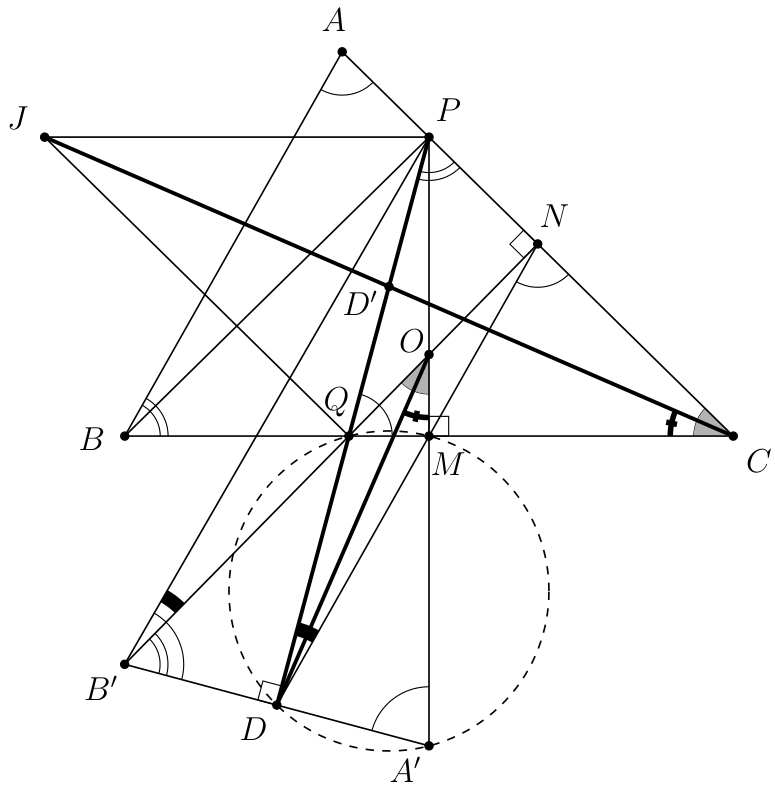
Let D′ be the intersection of CJ and PQ, and note that D′ is the midpoint of PQ since PCQJ is a parallelogram.
From the angle equalities established above we see that triangle QPC (with D′ as midpoint of QP) is similar to triangle A′B′O (with D as midpoint of A′B′). Thus ∠QCD′=∠A′OD, and so, since OA′⊥CQ, OD is perpendicular to CD′, i.e. to CJ.