To each side of a convex polygon we assign the maximum area of a triangle contained in the polygon and having as one of its sides. Show that the sum of the areas assigned to all sides of the polygon is not less than twice the area of the polygon.
(Serbia)
IMO Shortlist, 2006
Solutions — 2
Solution 1
Lemma. Every convex -gon, of area , has a side and a vertex that jointly span a triangle of area not less than .
Proof. By main diagonals of the -gon we shall mean those which partition the -gon into two polygons with equally many sides. For any side of the -gon denote by the triangle where are the endpoints of and is the intersection point of the main diagonals . We claim that the union of triangles , taken over all sides, covers the whole polygon.
To show this, choose any side and consider the main diagonal as a directed segment. Let be any point in the polygon, not on any main diagonal. For definiteness, let lie on the left side of the ray . Consider the sequence of main diagonals , where are consecutive vertices, situated right to . The -th item in this sequence is the diagonal (i.e. reversed), having on its right side. So there are two successive vertices in the sequence before such that still lies to the left of but to the right of . And this means that is in the triangle , . Analogous reasoning applies to points on the right of (points lying on main diagonals can be safely ignored). Thus indeed the triangles jointly cover the whole polygon.
The sum of their areas is no less than . So we can find two opposite sides, say and (with main diagonals) such that , where stands for the area of a region. Let intersect at ; assume without loss of generality that . Then
proving the lemma.
Now, let be any convex polygon, of area , with sides . Let be the area of the greatest triangle in with side . Suppose, contrary to the assertion, that
Then there exist rational numbers such that and for each .
Let be a common denominator of the fractions . Write ; so . Partition each side of into equal segments, creating a convex -gon of area (with some angles of size ), to which we apply the lemma. Accordingly, this refined polygon has a side and a vertex spanning a triangle of area . If is a piece of a side of , then the triangle with base and summit has area
in contradiction with the definition of . This ends the proof.
Solution 2
As in the first solution, we allow again angles of size at some vertices of the convex polygons considered.
To each convex -gon we assign a centrally symmetric convex -gon with side vectors . The construction is as follows. Attach the vectors at a common origin and label them in counterclockwise direction; the choice of the first vector is irrelevant. The order of labelling is well-defined if has neither parallel sides nor angles equal to . Otherwise several collinear vectors with the same direction are labelled consecutively . One can assume that in such cases the respective opposite vectors occur in the order , ensuring that for . Indices are taken cyclically here and in similar situations below.
Choose points satisfying for . The polygonal line is closed, since . Moreover, is a convex -gon due to the arrangement of the vectors , possibly with -angles. The side vectors of are , . So in particular is centrally symmetric, because it contains as side vectors and for each . Note that and are opposite sides of , . We call the associate of .
Let be the maximum area of a triangle with side in , . We prove that
and
It is clear that (1) and (2) imply the conclusion of the original problem.
Lemma. For a side of , let be the maximum distance from a point of to line , . Denote by the side of such that . Then the distance between and its opposite side in is equal to .
Proof. Choose a vertex of at distance from line . Let be the unit vector perpendicular to and pointing inside . Denoting by the dot product of vectors and , we have
In , the distance between the opposite sides and is given by
The choice of vertex implies that the consecutive vectors are precisely and , taken in some order. This implies .
For a proof of (1), apply the lemma to each side of . If is the centre of then, using the notation of the lemma,
Summation over all sides of yields (1).
Set for a convex polygon with associate . Inequality (2) means that for each convex polygon . The last inequality will be proved by induction on the number of side directions of , i.e. the number of pairwise nonparallel lines each containing a side of .
We choose to start the induction with as a base case, meaning that certain degenerate polygons are allowed. More exactly, we regard as degenerate convex polygons all closed polygonal lines of the form , where are points in this order on a line segment , and so are . The initial construction applies to degenerate polygons; their associates are also degenerate, and the value of is zero.
For the inductive step, consider a convex polygon which determines side directions, assuming that for polygons with smaller values of .
Suppose first that has a pair of parallel sides, i.e. sides on distinct parallel lines. Let and be such a pair, and let . Remove from the parallelogram determined by vectors and . Two polygons are obtained in this way. Translating one of them by vector yields a new convex polygon , of area and with value of not exceeding the one of . The construction just described will be called operation A.
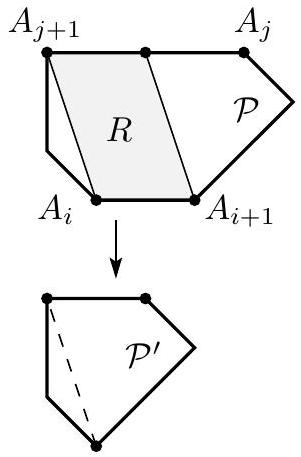
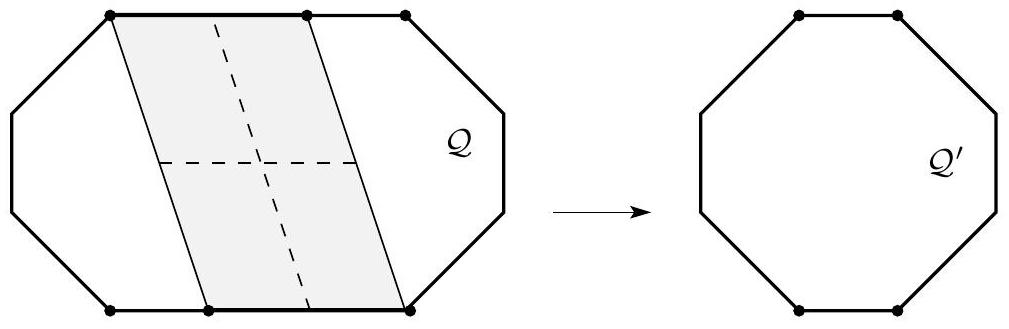
The associate of is obtained from upon decreasing the lengths of two opposite sides by an amount of . By the lemma, the distance between these opposite sides is twice the distance between and . Thus operation decreases by the area of a parallelogram with base and respective altitude twice the ones of , i.e. by . Hence leaves the difference unchanged.
Now, if also has a pair of parallel sides, apply operation to it. Keep doing so with the subsequent polygons obtained for as long as possible. Now, A decreases the number of pairs of parallel sides in . Hence its repeated applications gradually reduce to , and further applications of will be impossible after several steps. For clarity, let us denote by again the polygon obtained at that stage.
The inductive step is complete if is degenerate. Otherwise and , i.e. there are no parallel sides in . Observe that then . Indeed, means that the vertices of all lie on the boundary of a parallelogram, implying .
Furthermore, since has no parallel sides, consecutive collinear vectors in the sequence (if any) correspond to consecutive -angles in . Removing the vertices of such angles, we obtain a convex polygon with the same value of .
In summary, if operation is impossible for a nondegenerate polygon , then . In addition, one may assume that has no angles of size .
The last two conditions then also hold for the associate of , and we perform the following construction. Since , there is a side of such that the sum of the angles at and is greater than . (Such a side exists in each convex -gon for .) Naturally, is a side with the same property. Extend the pairs of sides and to meet at and , respectively. Let be the centrally symmetric convex -gon obtained from by inserting and into the sequence as new vertices between and , respectively. Informally, we adjoin to the congruent triangles and . Note that and are kept as vertices of , although and are no longer its sides.
Let be the side of such that . Consider the point such that triangle is congruent to triangle and exterior to . Insert into the sequence as a new vertex between and to obtain an -gon . We claim that is convex and its associate is .
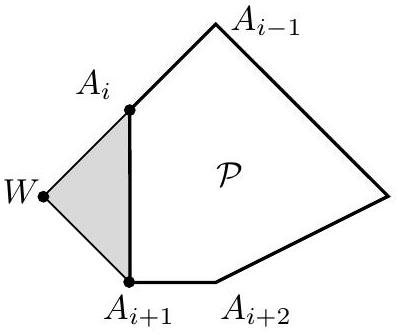
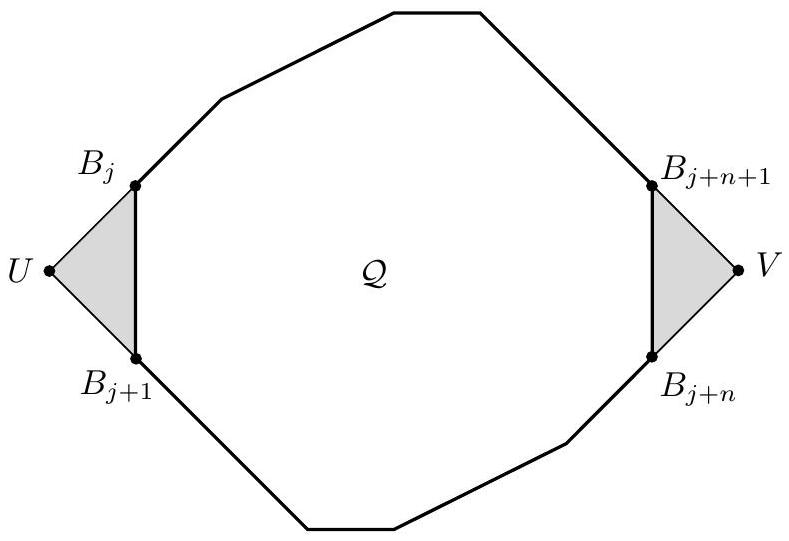
Vectors and are collinear and have the same direction, as well as vectors and . Since are consecutive terms in the sequence , the angle inequalities and hold true. They show that is a convex polygon. To construct its associate, vectors must be deleted from the defining sequence of , and the vectors must be inserted appropriately into it. The latter can be done as follows:
This updated sequence produces as the associate of .
It follows from the construction that and . Therefore .
To finish the induction, it remains to notice that the value of for is less than the one for . This is because side was removed. The newly added sides and do not introduce new side directions. Each one of them is either parallel to a side of or lies on the line determined by such a side. The proof is complete.
Want a route through all this instead of an archive? The track
puts 2,604 problems in a working order, from Junior Challenge level to the IMO shortlist.