There are 63 points on a circle C with radius 10. Let S be the number of triangles whose sides are longer than 9 and whose vertices are chosen from the 63 points. Find the maximum value of S.
Solution
Let O be the center of circle C, an is the length of a regular n-gon A1A2⋯An inscribed in ⊙O. Then a6=10>9, a7<10×72π<10×72×3.15<9.
(1) Let A1A2⋯A6 be a regular 6-gon inscribed in ⊙O, then AiAi+1=a6>9. So we can choose a point Bi in AiAi+1 such that BiAi+1>9. Then ∠BiOAi+1>72π (A7=A1), and ∠AiOBi=∠AiOAi+1−∠BiOAi+1<62π−72π<72π. It follows that AiBi<9 (i=1,2,…,6).
In each of A1B1,A2B2,A3B3, choose 11 points, and in each of A4B4,A5B5,A6B6, choose 10 points. We obtain a set M which has 63 points on the circle C. It is easy to see for M the value of S is S0, where S0=(33)×113+(23)⋅(13)×112×10+(13)⋅(23)×11×102+(33)×103=23121. So the maximum value of S is not less than S0.
(2) We prove that the maximum is S0. We need three lemmas.
Lemma 1 For P on circle C, we call the arc APB “an arc of P”, if P is the midpoint of arc APB, and ∠AOB=74π. Now for every given n points on circle C, there is a point P, such that there are ⌊6n+5⌋ points of the given n points on the “arc of P”.
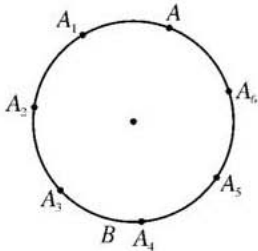
Proof: Let A be one of the given n points, and an “arc of A” be A1AA6. Now suppose A2,A3,…,A5 are on the arc A1A6 (not including A), and A1A2=A2A3=⋯=A5A6 (see the figure). So ∠AiOAi+1=72π,i=1,2,…,5.
If there is a point Pi (of the given n points) on AiAi+1, then all the points (of the given n points) on AiAi+1 are on “an arc of Pi”. So the given n points are on 6 “arcs of Pi” (including “arc of A”). This shows that there are ⌊6n−1⌋+1=⌊6n+5⌋ points of the given points on an “arc of Pi”, where Pi is one of the given n points.
Lemma 2 Take the arc A1BA6 arbitrary on the circle C with radius 10, where A1BA6 is 75 of the perimeter. Then take any 5m+r points on the arc A1BA6 (m,r are non-negative integers and 0≤r<5). Prove that number of lines from the given points whose lengths are more than 9 is at most 10m2+4rm+21r(r−1).
Proof: Divide A1BA6 in five equal parts, where the corresponding points are A2,A3,A4,A5 (see the figure), then the length of AiAi+1 is exactly 71 of the perimeter (i=1,2,3,4,5), and the distance of any two points is not more than a7<9. Suppose there are mi given points on the arc AiAi+1, then the number of lines from the given points whose lengths are more than 9 is at most l=1≤i<j≤5∑mimj,1◯ where m1+m2+⋯+m5=5m+r.2◯ Since there are finitely many non-negative integer groups (m1,m2,m3,m4,m5), the maximum value of l exists. Now we prove that when the maximum is attained the inequality ∣mi−mj∣≤1,(1≤i<j≤5), must hold.
In fact, if there exist i,j (1≤i<j≤5) such that ∣mi−mj∣≥2 when the maximum is attained, we can suppose m1−m2≥2. Then let m1′=m1−1,m2′=m2+1,m′=m, and the corresponding integer is l′, we will have m1′+m2′m1′+m2′+m3′+m4′+m5′l′−l=m1+m2,=m1+m2+m3+m4+m5,=(m1′m2′−m1m2)+[(m1′+m2′)−(m1+m2)](m3+m4+m5)=m1−m2−1≥1. Contradiction!
Therefore, when l reaches the maximum value, the number of m+1 is r and the number of m is 5−r. Thus, the number of lines from the given points whose lengths are more than 9 are at most (2r)(m+1)2+(1r)(5−r)(m+1)m+(25−r)m2=10m2+4rm+21r(r−1).
Lemma 3 Take arbitrary n points on the circle C with radius 10 to form set M, where n=6m+r (m,r are non-negative integers, 0≤r<6). Assume that there are Sn triangles whose vertices are from M and each side is longer than 9. Prove Sn≤20m3+10rm2+2r(r−1)m+61r(r−1)(r−2).
Proof: We shall prove by mathematical induction.
When n=1,2, Sn=0. It is true.
Suppose when n=k, it is true and set k=6m+r (m,r are non-negative integers, 0≤r<6). Then Sk≤20m3+10rm2+2r(r−1)m+61r(r−1)(r−2). From Lemma 1, when n=k+1, the k+1 given points must include the point P, where at least ⌊6k+1+5⌋=m+1 given points are in the 72arc A1PA6. And the distances of such points to P are ≤PA1=PA6=a7<9. Hence, there are at most (k+1)−(m+1)=5m+r given points whose distances to P are more than 9, and such points are all in the other 75arccosA1PA6 without P. From Lemma 2, the lines from such points whose lengths are more than 9 are at most 10m2+4rm+21r(r−1). (From Lemma 2, when r=5, it is 10(m+1)2, which is also true.) Thus, the number of triangles whose vertex is P and each side is larger than 9 is not more than Sp=10m2+4rm+21r(r−1). Without P, there are k=6m+r given points. Let there be Sk triangles whose vertices are from the k points and each side is larger than 9, then using mathematical induction, we get Sk≤20m3+10rm2+2r(r−1)m+61r(r−1)(r−2). Furthermore Sk+1=Sk+Sp≤20m3+10rm2+2r(r−1)m+61r(r−1)(r−2)+10m2+4rm+21r(r−1)=20m3+10(r+1)m2+2r(r+1)m+61r(r−1)(r+1), which means the case n=k+1=6m+(r+1) is also true.
On the other hand, when r=5, then m=k+1=6(m+1) and Sk+1 can be simplified to Sk+1=20(m+1)3, which is also true.
Therefore, we have proved Lemma 3.
Now considering the original problem, we have n=63=6×10+3. It follows from Lemma 3, S≤20×103+10×102+2×3×2×10+61×3×2×1=23121. Thus, Smax=23121.
Want a route through all this instead of an archive? The track
puts 2,604 problems in a working order, from Junior Challenge level to the IMO shortlist.
Source: MathNet,
licensed CC-BY-4.0.
Statement reproduced verbatim; metadata (topic, difficulty) added by this project.