The radius of the circumcircle of an acute triangle is and its orthocenter is . Show that .
Estonian Math Competitions
Solutions — 2
Solution 1
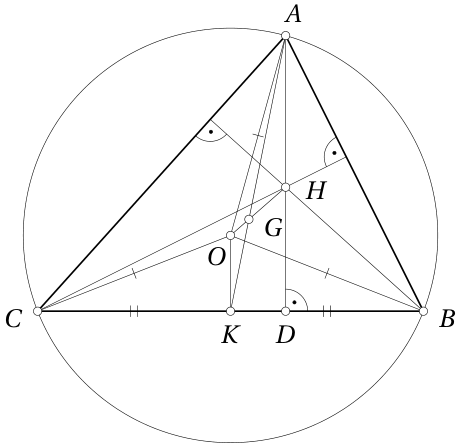
Let and be the circumcenter and centroid of respectively and let be the midpoint of (Fig. 33).
We know that . Also we know that , and are collinear with (Euler line). So triangles and are similar with scale factor (by proportional sides and an equal angle between them). Therefore .
Now the Pythagorean theorem in triangle yields and .
Solution 2
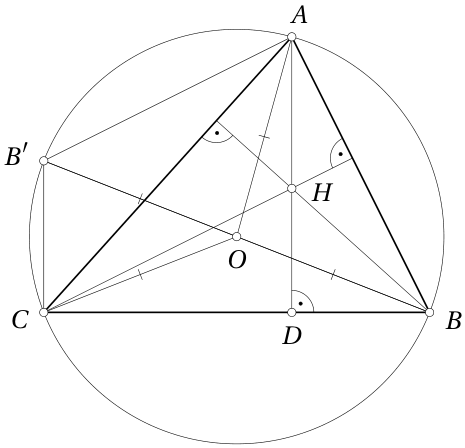
Let be the other end of the diameter to the circumcircle of drawn from (Fig. 34). Since and are perpendicular and and are perpendicular, the lines and are parallel. Similarly, we see that and are parallel, meaning that is a parallelogram. Thus .
Now the Pythagorean theorem in triangle yields . As and , the desired result follows.
Want a route through all this instead of an archive? The track
puts 2,604 problems in a working order, from Junior Challenge level to the IMO shortlist.