Maths Olympiad Prep

Library / /23 of 39

Geometry Difficulty 5.5 AIME, harder Prove it Ireland

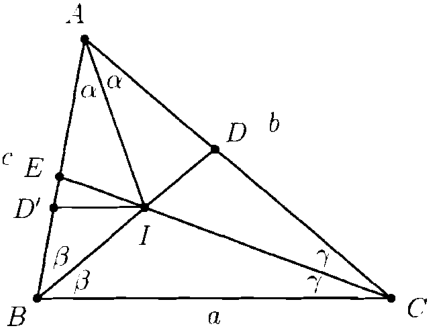
In the triangle ABCABC we have AB<AC|AB| < |AC|. The bisectors of the angles at BB and CC meet ACAC and ABAB at DD and EE respectively. The lines BDBD and CECE intersect at the incentre II of ABC\triangle ABC.
Prove that BAC=60\angle BAC = 60^\circ if and only if IE=ID|IE| = |ID|.

Solution

Let BAC=2α\angle BAC = 2\alpha, CBA=2β\angle CBA = 2\beta and ACB=2γ\angle ACB = 2\gamma. Assume first that 2α=BAC=602\alpha = \angle BAC = 60^\circ. This implies 2β+2γ=1202\beta + 2\gamma = 120^\circ, i.e. β+γ=60\beta + \gamma = 60^\circ. Hence, DIE=BIC=120\angle DIE = \angle BIC = 120^\circ. Therefore, BAC+DIE=180\angle BAC + \angle DIE = 180^\circ and the quadrilateral EIDA is cyclic. As AIAI bisects BAC\angle BAC, the chords EIEI and DIDI subtend angles of 3030^\circ at the circumference of the circumcircle of EIDA. This implies IE=ID|IE| = |ID|.

Figure 1

Conversely, assume IE=ID|IE| = |ID|. The bisector BDBD divides CACA in the ratio AB:BC|AB| : |BC|. This can easily be seen from the sine rule for the two triangles BDA\triangle BDA and BCD\triangle BCD and using that sin(180x)=sin(x)\sin(180^\circ - x) = \sin(x).
Let BC=a|BC| = a, CA=b|CA| = b and AB=c|AB| = c. From CDDA=ac\frac{|CD|}{|DA|} = \frac{a}{c} and CD+DA=b|CD| + |DA| = b we obtain DA=bca+b|DA| = \frac{bc}{a+b}. Similarly we get AE=bca+b|AE| = \frac{bc}{a+b}. Because CA>AB|CA| > |AB| by assumption, we have b>cb > c and so bca+c>bca+b\frac{bc}{a+c} > \frac{bc}{a+b}, hence DA>AE|DA| > |AE|.
Let DD' be the reflection of DD in AIAI. Since DA>AE|DA| > |AE|, DD' will lie between EE and BB on ABAB. Then AIDAID\triangle AID \equiv \triangle AID', hence ID=ID|ID'| = |ID| and IDA=ADI=2γ+β\angle ID'A = \angle ADI = 2\gamma + \beta. Since IE=ID|IE| = |ID| we have IE=ID|IE| = |ID'| from which we get DEI=IDA=2γ+β\angle D'EI = \angle ID'A = 2\gamma + \beta. From IEA=2β+γ\angle IEA = 2\beta + \gamma we obtain now
180=IEA+DEI=2β+γ+2γ+β=3(β+γ), 180^\circ = \angle IEA + \angle D'EI = 2\beta + \gamma + 2\gamma + \beta = 3(\beta + \gamma),
which implies β+γ=60\beta + \gamma = 60^\circ. Since α+β+γ=90\alpha + \beta + \gamma = 90^\circ, we get α=30\alpha = 30^\circ and so BAC=2α=60\angle BAC = 2\alpha = 60^\circ.

Want a route through all this instead of an archive? The track puts 2,000 problems in a working order, from AMC 10 level to the IMO shortlist.

Source: MathNet, licensed CC-BY-4.0. Statement and solution reproduced as published; topic and difficulty added by this site.