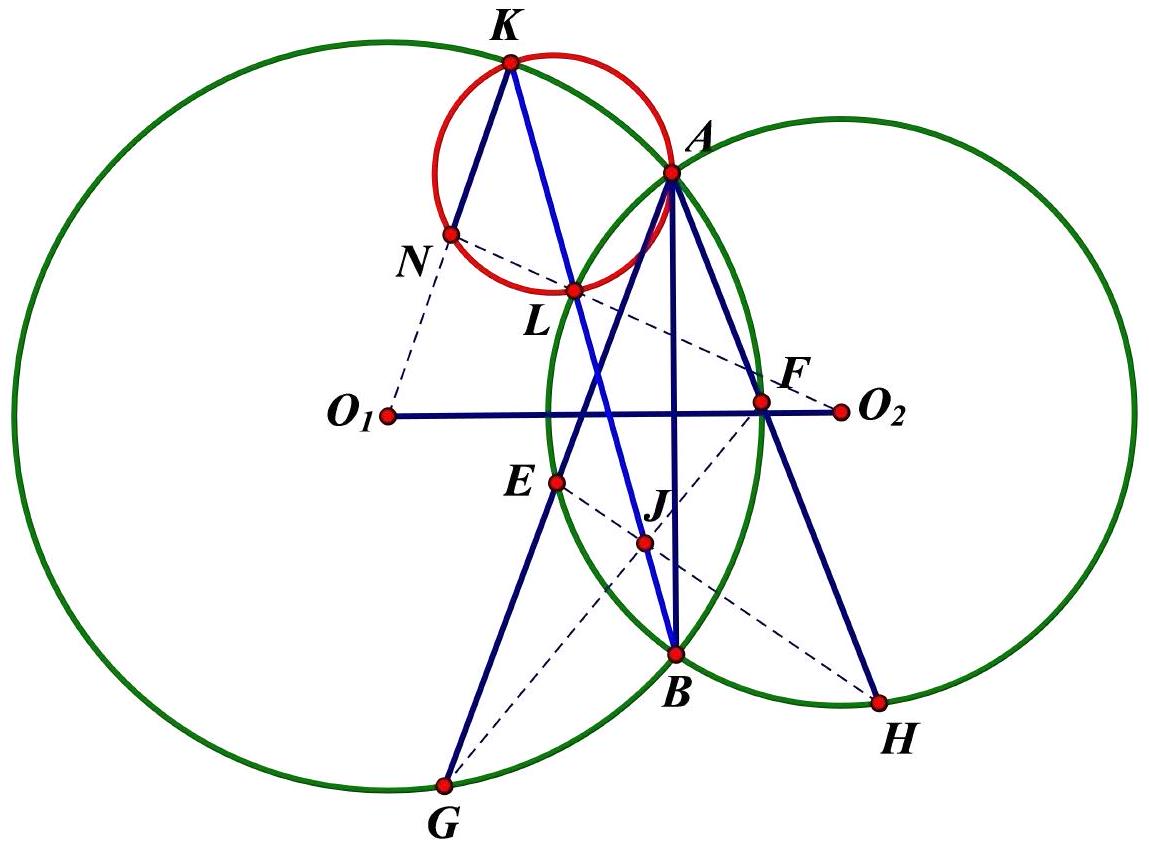
Given two circles O1 and O2 intersect at A and B. Let d1 and d2 be two lines through A and be symmetric with respect to AB. The line d1 cuts O1 and O2 at G, E (E=A), respectively; the line d2 cuts O1 and O2 at F, H (F=A), respectively; such that E is between A, G and F is between A, H. Let J be the intersection of EH and FG. The line BJ cuts O1, O2 at K, L (K,L=B), respectively. Let N be the intersection of O1K and O2L. Prove that the circle (NLK) is tangent to AB.
Solution
We have ∠AKO1=90∘−21∠AO1K=90∘−∠ABK=90∘−∠ABL=90∘−21∠AO2L=∠ALO2 Therefore ALNK is a cyclic quadrilateral.
Let O be the circumcenter of quadrilateral ALNK. Since B is the intersection of (AGF) and (AEH) then B is the Miquel point of complete quadrilateral AEJF.GH or B∈(JFH).
We obtain BAO = BAK + KAO = BAF + FAK + 90 - ALK = 1 2 ( BF + FK ) + 90 - AHB = 1 2 ( BG + FK ) - GJB + 90 = 90 . From this, AB is a tangent of (O). We are done.
Want a route through all this instead of an archive? The track
puts 2,604 problems in a working order, from Junior Challenge level to the IMO shortlist.
Source: MathNet,
licensed CC-BY-4.0.
Statement reproduced verbatim; metadata (topic, difficulty) added by this project.