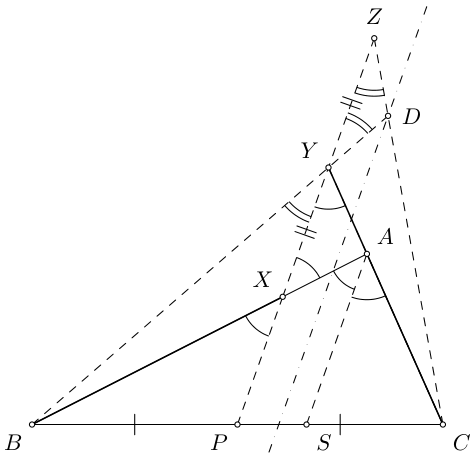
Let ABC be a triangle such that ∣AB∣>∣AC∣. Let P be the midpoint of the segment BC and S the intersection of the bisector of the angle ∠BAC and the segment BC. The line parallel to the line AS, which passes through P, intersects the lines AB and AC in points X and Y respectively. Let Z be a point such that Y is the midpoint of the segment XZ, and that lines BY and CZ intersect at D. Prove that the bisector of the angle ∠BDC is parallel to the line AS. (D. Monk, New Problems in Euclidean Geometry)
Solution
Since ∣BP∣=∣CP∣ and ∣BP∣∣BX∣=(similarity)=∣BS∣∣BA∣=(angle bisector)=∣CS∣∣CA∣=(similarity)=∣CP∣∣CY∣, we conclude that ∣BX∣=∣CY∣. Note that △XYA=△SAC=△BAS=△BXP=△AXY, and therefore △YXB=△CYZ. Since ∣XY∣=∣YZ∣ and ∣BX∣=∣CY∣, the SAS congruence theorem implies that the triangles BXY and CYZ are congruent. Hence △BYP=△PZC, i.e. △DYZ=△YZD. Since △DYZ+△YZD=△BDC, it follows that the bisector of the angle △BDC is parallel to the line ZP, and hence to the line AS as well.
Want a route through all this instead of an archive? The track
puts 2,604 problems in a working order, from Junior Challenge level to the IMO shortlist.
Source: MathNet,
licensed CC-BY-4.0.
Statement reproduced verbatim; metadata (topic, difficulty) added by this project.